


The Yara
Wings of Providence begins with The Yara, which servers as a prelude describing the circumstances surrounding the birth of the protagonist, Diallo. The Yara provides a necessary glimpse of Diallo’s mother, Luala, and the close bond she had with Diallo’s father, Mosai. Since it is the absence of his parents that has such a profound influence on Diallo’s development, it seems only appropriate that his story begins with the reasons for their absence – Luala’s death, and Mosai’s subsequent withdrawal.
Overview
| Scene One |
It opens with a girl emerging from the morning mist as she ascends Overlook Hill to sit beneath the lone acacia tree at its top. This is the spot where all potential mothers in the village hear their yaras for the first time, so this is where she has been coming for weeks now to hear her child’s yara. The yara is the birth song that all mothers must hear after marriage and prior to sexual conception. The true birth of a child is said to be when its mother hears its yara for the first time. It’s a birth song that reflects a child’s individual spirit and becomes intimately linked with them for life. Sitting beneath the acacia, the girl imbibes a drug to help induce the yara experience. Having heard her child’s yara, she then descends Overlook Hill and enters the dense jungle forest at its base. She comes to a massive tree with a staircase carved within its trunk, spiraling up into the canopy of the forest. The girl climbs the stairs humming the yara, and makes her way to the village of Ephrathah, which is built within the upper branches of the forest. This first scene ends when she comes to her husband’s hut and wakes him so she can sing to him their child’s yara.
| Scene Two |
In this scene Mosai is carrying two gourds of water and clay slung across his back as he climbs a towering emergent tree that rises far above the rest of the forest, overlooking the village built within the canopy below him. Coming to a large platform supported by the emergent tree’s upper branches, he enters what we learn to be the men’s fire circle, which consists of four separate fire circles built upon the platform. Wanting to be alone, Mosai ignores the other men present there and finds himself an uninhabited fire circle. Working there alone, he takes the clay and begins fashioning Luala’s boma – a pot-shaped funerary vessel designed to hold the remains of the deceased. Working on his dead wife’s boma, it becomes clear how distraught Mosai is due to his loss as he is tormented by a series of flashbacks concerning Luala. The first of these takes us back to when Mosai is woken up in hut by Luala when she came to teach him their child’s yara. It is at this point that we discover the girl from the first scene was in fact Luala. Back in the present, Mosai begins to fill in the ribbed gaps of Luala’s boma, smoothing the clay across its surface and caressing it as he had once caressed his wife. This triggers the flashback of Diallo’s conception. Mosia recalls how he and Luala were singing their child’s yara together as they began to make love for the first time. Eventually, other voices are heard through his hut’s walls, voices joining him and Luala in song as all those within earshot learn and sing Diallo’s yara, welcoming the new child into existence and inviting him to join their tribe.
| Scene Three |
This scene begins with Mosai engraving Luala’s yara within the clay along the upper rim of her boma. Working with her yara like this initiates another flashback to when Luala was in the final stages of her pregnancy with Diallo. Mosai had been hiding and waiting for her within a tree along the bank of the Dula River when Luala arrived to cool herself within the water beneath the tree. Mosai watched his wife secretly from above as she poured water over her distended womb protruding from the river. Mosai frightened her then as he began playing Luala’s yara on his kulu – a small flute made from the hollowed bone of a vulture. Back in the present and having fired Luala’s boma within the flames of the firepit, Mosai is now testing its integrity by placing his ear to its now hardened surface and listening to its resonance as he taps it with a finger. This takes him back in time again to that day by the Dula River with Luala, when he had his ear to her belly to hear the kicking of their child. Luala informed him that the child seemed to be responding to the sound of the music coming from his flute but would only kick when Mosai played his own yara. So, laying within the shallows of the river, Mosai placed his ear to Luala’s womb while playing his own yara on the kulu, listening to his child thumping back at him. Back in the present, Mosai puts the finishing touches on Luala’s boma, applying the paint as he depicts a large moth on its midsection. This is a personalized symbol that is associated with Luala, which triggers the last flashback. The moth is linked to Luala due to the amulet she always wore around her neck – a chunk of amber with a trapped moth embedded within it. The last time Mosai looked upon that moth and amulet was the evening Diallo was born. When a mother’s time grows near, they undertake a journey down the Dula River to The Great Mother – a giant baobab tree with a birthing chamber hollowed out of the base of its trunk. Every member of the tribe is born in the flesh from this tree. It stands alone, away from the four villages, within the flat expanse of a mud-cracked plain. The last flashback begins with Mosai and his friend Makoa playing music and waiting together around a fire some small distance from The Great Mother. An evening storm is brewing and Mosai sees his grandmother, Wanyana approaching from the dark tower of the birthing tree. He was expecting Wanyana to bring his newborn child to him, but instead all she brought was Luala’s amulet, which she gave to him. Wanyana tell him that he has a son now who is back in the birthing chamber with a wetnurse, but that Luala herself did not survive the birth.
| Scene Four |
This last scene opens with Mosai emerging from the evening mist, carrying Luala’s boma as he ascends Overlook Hill. He passes by the lone acacia at its top and continues to the far side of the hill where he comes to a hole already dug along the edge of the forest there. He places Lual’s heart, liver, kidney, and her red-painted skull into the boma. Then he adds dirt, along with a scattering of seeds, and places the boma into the hole. He fills in the hole and covers it over with dirt as he sings Lual’s yara for the last time, then in the dying light of the sun he plays Lual’s yara for the last time on his kulu. Mosai slowly heads back to the village, no longer the man he was, as he slowly descends back down the hill and into the growing mist.

Notes & Reflections
The beginning and the ending of the Batu is through music.
These are the first words in the opening of The Yara. The concept of the yara as an individualized birth song is one of the most ubiquitous cultural elements found throughout the series. As a personalized identifier, the song known as a yara is used as an integral component within every significant ritual or rite of passage a person may undergo throughout the course of a life.
As a prelude to Wings of Providence, The Yara uses this concept not only in relation to the birth of Diallo but also to the death of his mother, Luala. The structure of the prelude is framed by these two yaras, placing Diallo’s in the first scene and Luala’s in the last. The title of the prelude can also be seen as a reference tot the birth of the entire series which begins with the birth of its protagonist and ends with the death of the Batu as a tribe.
One of the primary functions of The Yara though is the setting of the stage, and the most memorable staging prop is arguably that of the physical environment of Diallo’s village, Ephrathah. Built as it is within the lofts of the jungle canopy, it serves as a clear signal for the reader that the story that is about to unfold will be going far beyond historical realism. The idea of a village built within the treetops sixty to a hundred feet off the ground brings to the experience a visual grandeur that both literally and figuratively raises it above the world of anthropology and ethnology and into a new world with fewer limitations.
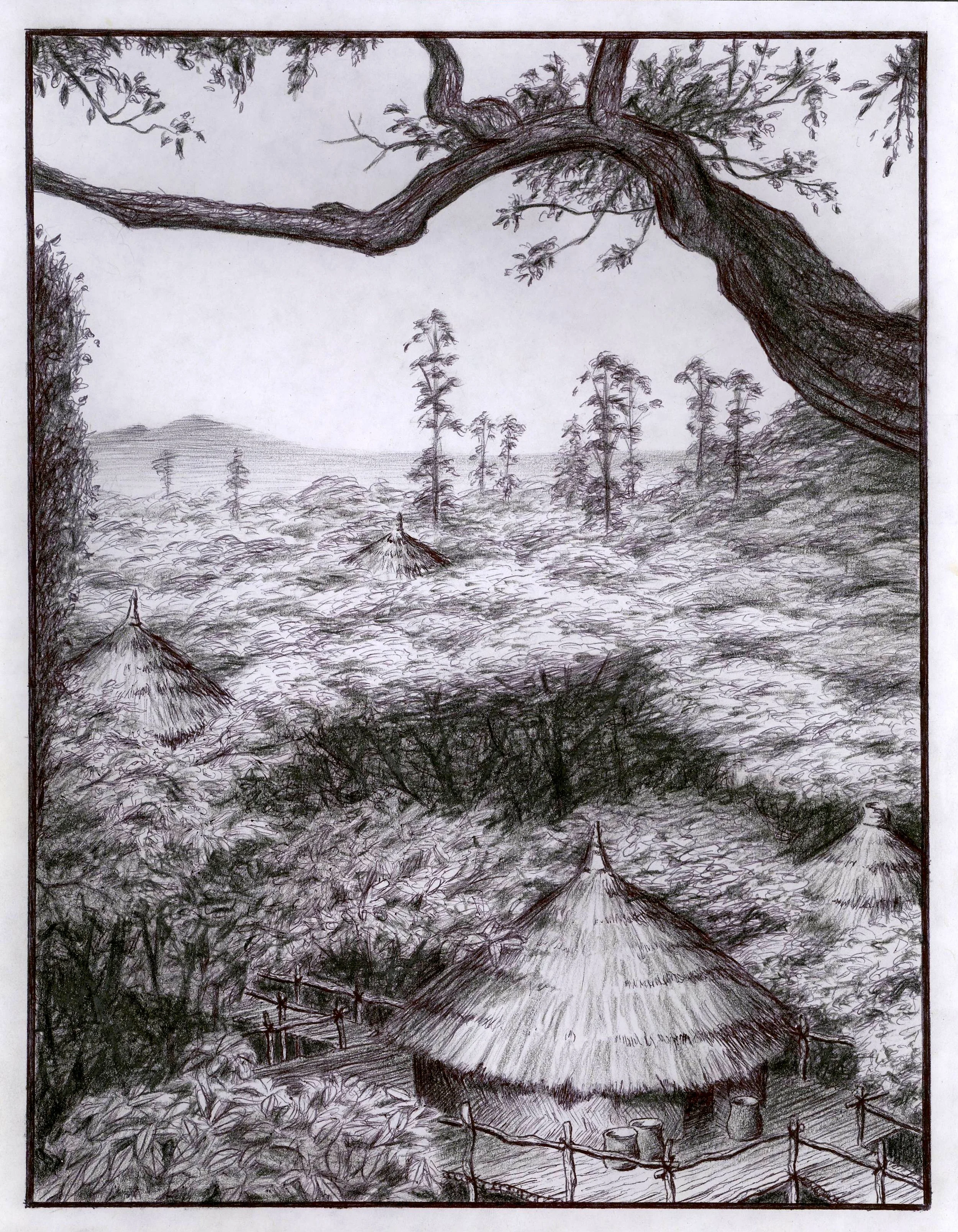
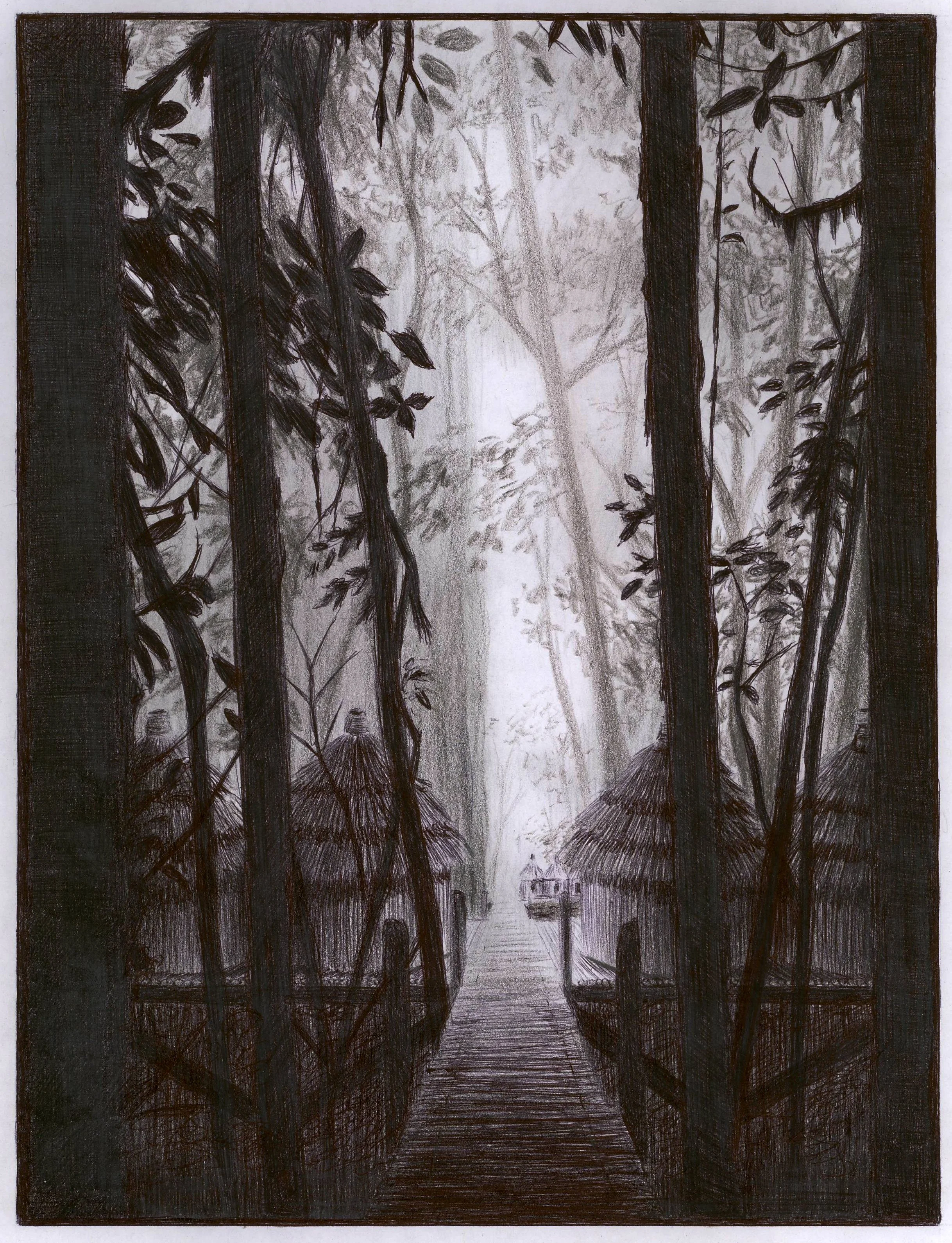
Yet throughout all four books a rationale is always provided for even the most fantastic aspects of the story. For the treehouse architecture of the village, it is explained that life could only flourish in the lofts high above. Due to its density, no light ever reaches the forest floor, while the oppressive heat of midday gets trapped there and turns it into a virtual oven. Therefor, as with all the other lifeforms of the jungle, the villagers of Ephrathah live within the canopy because it is uninhabitable below.
Another example of providing plausibility to the fantastic is found within the yara concept itself. If every mother had to wait for the mystical experience of hearing her child’s yara prior to sexual conception, the population of the tribe would soon find itself in dire straits. Mystical experiences, almost by definition, should not be that common or dependable. When Diallo is sexually conceived by Mosai and Luala there is a suggestion of a choice being made.
This was their first time together. They’d agreed to wait for the yara.
This implies that some may choose not to wait, though it is not explained whether this then would be playing Russian Roulette, or what would happen to a child that is conceived without a yara. But a causative agent is introduced to the yara experience by way of a drug as a fail-safe. This is depicted in The Yara with Luala.
A particularly strong solution, but she’d been growing rather impatient the last couple weeks and would take whatever help she could get.
It would seem that even the protagonist of the tale is not so special that he is allowed a mystical birth without the aid of a drug.
Moving from this first scene where Diallo’s spirit is born through his yara, and where the village environment is introduced, we come then into the second scene where Luala is already dead. From this point on she will be perceived only through Mosai’s memories in a series of flashbacks. Flashbacks that are triggered by hi work on Luala’s boma. The word boma is today found in north African languages, meaning fortress, or a camp. This suggests the interesting possibility that the Batu funerary vessel may have been itself viewed as a place of safety or refuge following the toils of life. Except for the first and the last scene in The Yara, the making of the boma is used as the core support structure that all the other scenes are built around.
It would seem, however, that the process of making Luala’s boma is not merely a transitional device for Sumner to move between scenes, but is used as a metaphorical device as well. The boma-making process lends itself to multiple interpretations though. Since The Yara is ostensibly about the birth of Diallo, it could be said that the making of the boma reflects the making of a child – the making of Diallo. It could also be argued that the wording of the process, and the care put into it, suggests that it represents the building of relationships.
But the most likely interpretation is that it is meant to echo the making of a story – the craft of writing fiction. In fact, it seems probable that the process of making the boma is Sumner’s own way of commenting on the making of the very story The Yara is intended to introduce.
He knew he had to choose his material carefully. Proper foundations are critical.
You can’t rush beginnings if you want the work to last. You must take as much time as you need to find just the perfect ingredients before beginning to build. When he entered the coe along the Dula River, the alluvial embankment rippled with the tell-tale colors. He knew it would be perfect. He knew this clay would dry correctly without cracking in the fires. Exposing your creation to the flames is the final stage and true test. But if you have done your job conscientiously, and with heart, it will pass through the flames of criticism and emerge stronger than ever.
Mosai scooped the clay out onto slabs of bark and began squeezing it through his fingers, carefully weeding out all the lumps and pebbles he could find. Having good raw material, it was then necessary to sift out all the contaminants that would later weaken the whole. Possibly even causing it to fall apart in his hands. So, Mosai took his time, kneading the clay over and over into a uniform consistency.
Then, taking the ground up cowrie shell, he added the powder with the clay and mixed it in thoroughly with his fingers while continuing to make sure the clay remained free of unwanted material. Give it what it needs for strength, remove what weakens it. Couldn’t be more simple.
And Sumner even seems to be tying in this beginning of the series with the end of it, suggesting he knows well in advance how it will all come to an end four books later.
A thick, strong foundation building to a thinner yet broader conclusion.
THE BOMA BREAKTHROUGH
According to Thornton Sumner, the prelude now known as The Yara went through several failed incarnations before he stumbled upon the idea of using the boma-making process as a structural support. “It was the boma, and it potential uses as a plot device, and for scene transitions, that completely opened up the whole thing for me in a creative way. It meant I would have to relay half the scenes within flashbacks, which frankly scared me, but I believed the pros outweighed the cons.”
It was rereading Neil Gaiman’s, The Kindly Ones – the last compilation of his Sandman graphic novel series – that inspired Sumner to use the boma as a metaphor. In The Kindly Ones, it opens with the furies – the Greek triple goddess representing the Fates, sitting around sipping tea and spinning yarn as they converse in double entendres about the weaving of a story. The notion of beginning a story by commenting on the making of a story was too irresistible to pass up.
Of course, the boma is used by the story’s characters for their own metaphorical purpose as well. Most notably by Mosai, who looks upon the boma almost as if it were Luala herself.
This will be her new body.
The boma is the new shell that will be housing Luala’s soul. But as Mosai carves the python Gao into the base of the vessel, the boma is revealed to be much more than a shell. The boma is a symbol for the World Tree, Obamti, which Gao supports as she wraps around its foundations. Gao is the guardian of this gateway into Alodia, the underworld. Alodia is where Luala is now headed, and the World Tree is one of its four gateways. Like the boma itself, it is a bridge between realms. The boma then represents two senses of the word vessel here, both as a container and as a vehicle that will convey her on her journey to Alodia.
Though the boma is symbolized as Obamti, it also manifests itself in the fourth scene as The Great Mother, where Diallo is physically born. This tree is believed by the tribe to be a bridge that spans and connects all four realms of existence: the celestial realm, the sky, the world, and the underworld.
Known as The Great Mother, this baobab was the tree from which their entire tribe was born. Every member of the Batu – from all four bands – arrived through the gateway of The Great Mother. She was their bridge connecting this world with the other three.
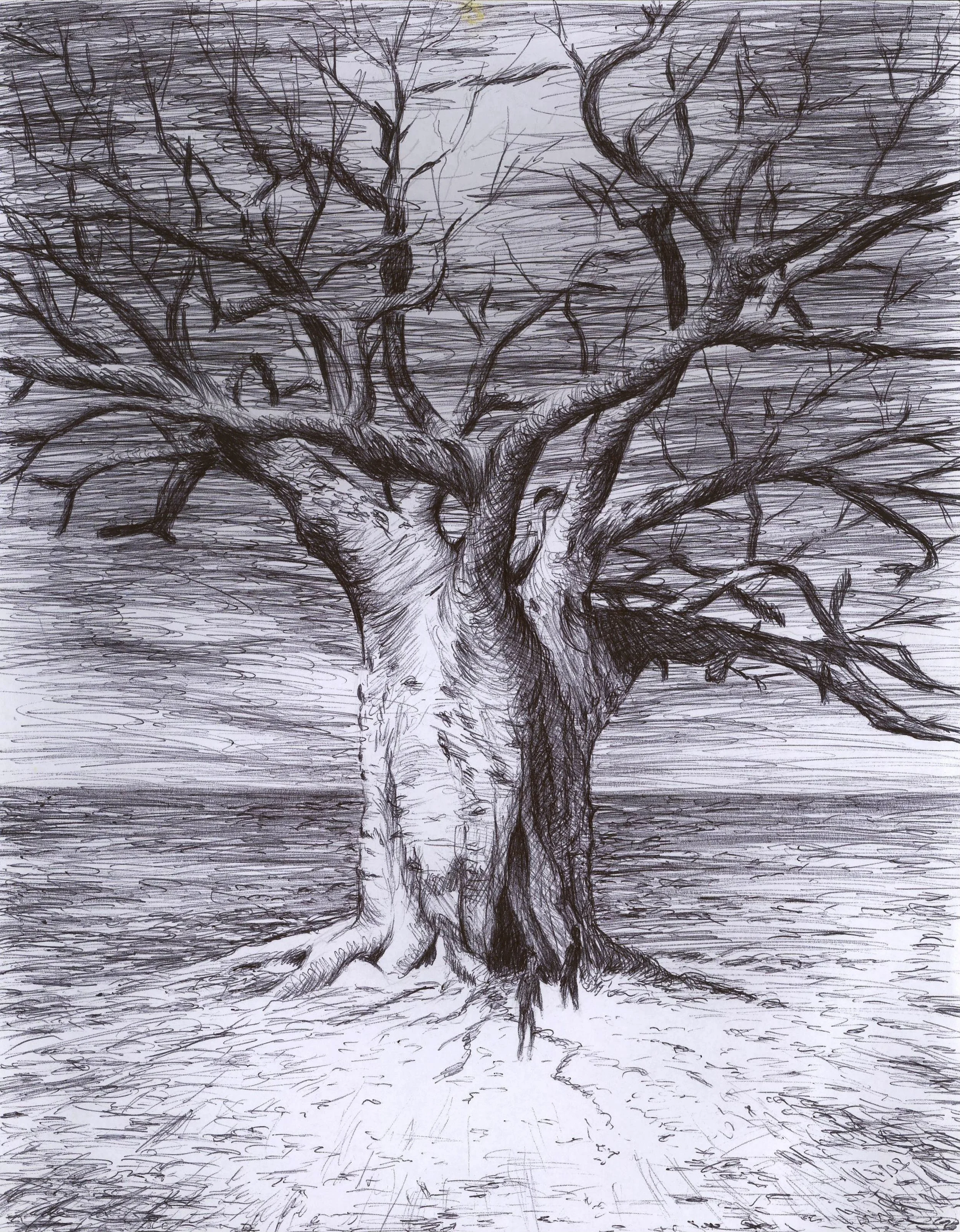
And it is here, at The Great Mother, where the prophecy – The Song of Mugasha – is first hinted at. Though the details of the prophecy are only revealed bit by bit throughout the course of the book, it first appears here as an ominous shadow that is cast over Diallo’s birth. The shadow is, in fact, cast by Mosai, whose resentment of the prophecy and his place within it is made clear.
He had longed to escape his burden his whole life. But not like this. He didn’t want to pass it on to his..But it could be a girl.
Luala’s amulet is passed on for Diallo in this scene as well. The likelihood of harvesting a chunk of amber that encapsulates a moth the way this amulet does should be a good indicator of its value as a sacred object. Its function isn’t revealed until the last chapter in Wings of Providence, when Diallo actually receives it, but it’s already clear within The Yara that it holds some special importance. Mosai is reflecting on this as he paints the moth on Luala’s boma.
It would be a symbol with him forever linked to Luala and the amulet she always wore around her neck. She never spoke of it openly, and he never inquired about it, but he knew she was somehow deeply attached to that amulet. He never saw one like it in his travels, but he had the moth associated with it locked within his memory.
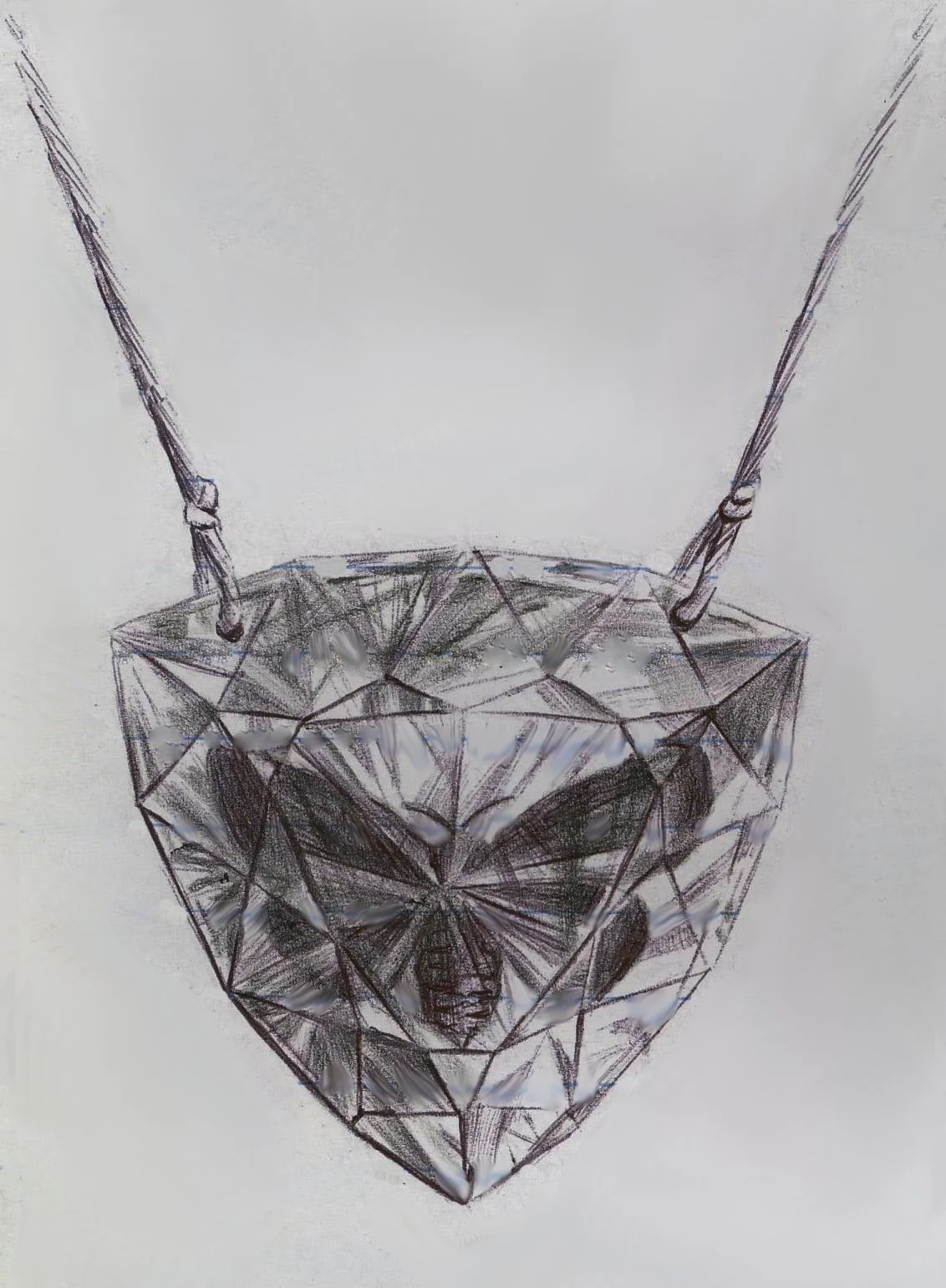
Like the moth locked within the amber. The moth is presented as a symbol for Luala’s spirit, and it’s being handed down to her son, Diallo, so she can look over him through the amulet. Painting this image of the moth on Luala’s boma triggers the memory of her death for him.
The day he last saw that moth would forever remain the worst day of his life.
Which stand in sharp contrast to what he said about that day right after he learned that he was now a father.
“I will always remember this day as the greatest of my life.”
This dramatic shift in perspective foreshadows how Luala’s death would leave Mosai forever changed and incapacitated as a father, his ultimate failure beginning right here with his inability to find value in the existence of his son. He never establishes a meaningful connection with Diallo and becomes a mere shadow of himself. The change in him is as quick as it is irrevocable.
Everything was different. He was a different man, though it had been less than a moon ago.
Mosai’s distancing himself from his son would not be just an emotional one, however, but a geographical one as well. After Luala’s death, Mosai will be continually away on long hunting excursions for most of Diallo’s youth. It is not clear though how much of this in intentional and how much of his behavior is unconscious. There are suggestive hints though within The Yara.
Mosai looked down at his dry, cracked hands, thinking that when he’s done here, perhaps it would be better if he just went away – disappeared. Everything he touches gets destroyed. He flexed his fingers, having the very sight of them, as if his curse resided there alone.
The problematic relationship with his father is a necessary ingredient though for Diallo. It is central in the formation of his character and is underscored by Wanyana when she warns the boy that he has inherited his father’s disease. But there is foreshadowing even here in The Yara that Diallo might be destined to follow in Mosai’s eccentric footsteps. While still in Luala’s womb he would kick to the sound of his father playing his kulu, but when Mosai rests his ear to Luala’s belly to listen it turns out that her child only responds to the music of Mosai’s own yara.
As noted by Luala:
We have a spirited child who… who seems to dance to its father’s tune.”
The Yara ends with scene four, serving as a dark mirror of the first scene. Whereas scene one illustrates the birth of a soul through the hearing of Diallo’s yara for the first time, the last scene is about the death of a soul through the hearing of Luala’s yara for the last time. Also, many of the details in both scenes are carefully orchestrated to mirror one another.
This isn’t cheeky word play or structural aesthetics, it imparts an organic progression and shift in mood that is reflected throughout the entire series. Everything begins in beauty, innocence, and with a lust for life, but invariably falls apart and dwindles into darkness.

An Interview With the Author
Birth Songs, Reincarnation, and Christianity
MM: Where did the yara concept come from? Did you invent that?
TS: No, I was reading Jack Kornfied’s A Path With Heart, and he had a couple paragraphs describing an East African tribe that considered a child’s true birth to be when its mother first formed the intention of having a child. It wen on to describe the birth song associated with the child for life, just as I have it with the Batu. It was an idea I found utterly beautiful. And it’s interesting because this was the first thing I stumbled upon that sparked the entire Batu project for me.
MM: Nice. The concept of a birth song gave birth to your novels.
TS: Yeah, except it didn’t start out as an idea for a novel. After being moved by this birth song concept I began gathering cultural tidbits from my random reading interests, with only a vague notion of building an imaginary society. A utopian society. I guess you could say I was disenchanted with my own culture and was setting out to form a new and more beautiful one. A simpler one, eventually focusing on African ethnology. But even by the time my tribe had a name, and having created a rudimentary language and form of writing for them, I still only thought of it as my Batu project. It wasn’t a novel. The impetus for the story came much later.
MM: So, all your cultural elements came from research?
TS: The less ludicrous elements, I suppose so. But not things like building an entire village within the treetops.
MM: Or a spiral staircase carved into the trunk of a giant tree?
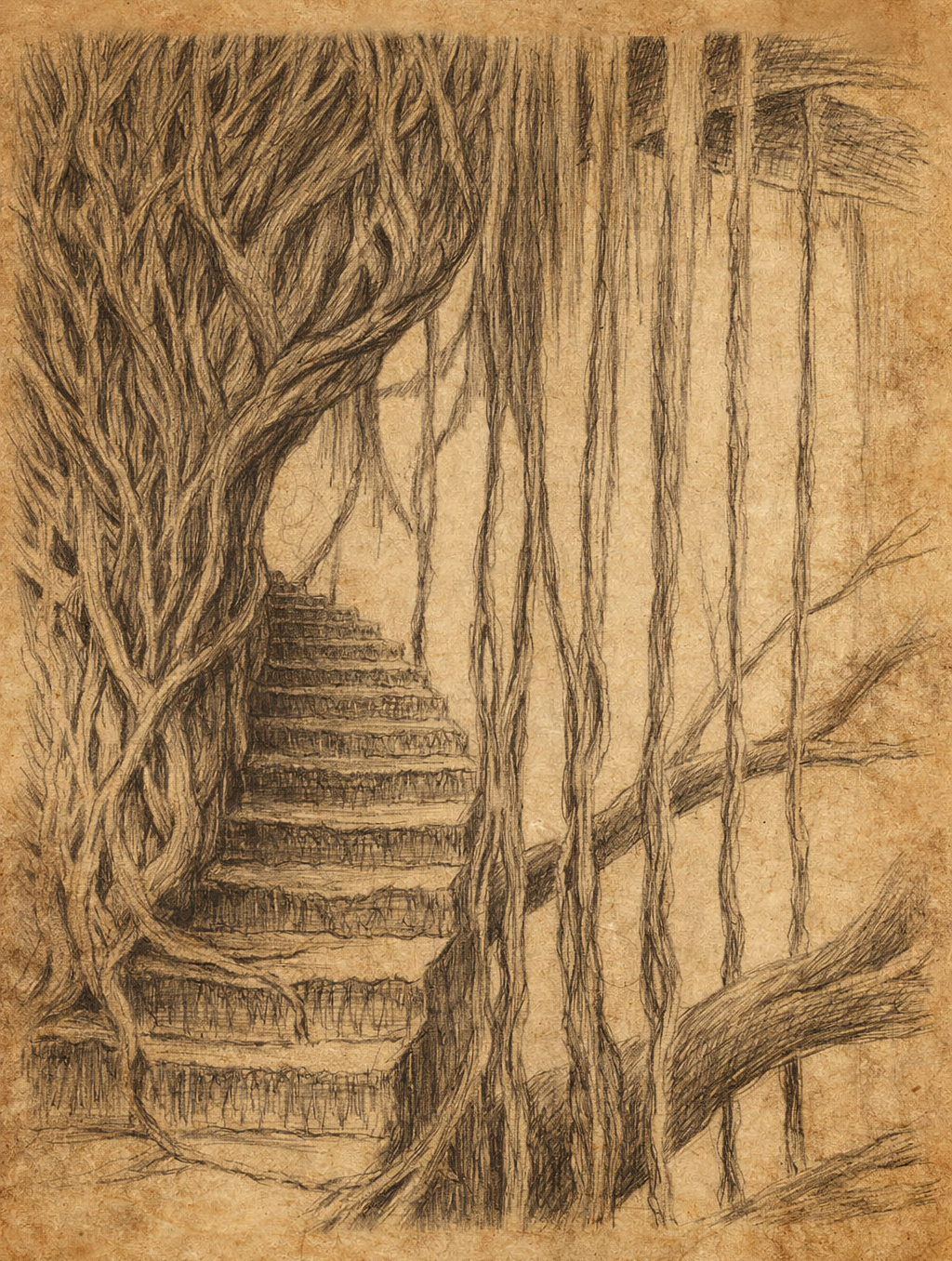
TS: Yeah, those were major creative choices to intentionally divorce myself from the constraints of realism. But you’re right, the majority of Batu ethnology comes from research. There isn’t much though that I don’t tweak to better suit my own personal sense of aesthetics, or for the needs of the story. But I suppose you can look upon the Batu as a sort of pan-African cultural pastiche. I always justified this for myself though by arguing that my tribe predates African history, and any cultural nuances the reader may recognize from modern tribal societies is because they’re descendants of the Batu.
MM: Convenient.
TS: Isn’t it?
MM: What sort of tweaking did the yara concept get
TS: Well, for one thing, the term yara is my own.
MM: Okay…
TS: I also more closely identify it with a person’s soul or spirit. In fact, I use the yara within their spiritual belief system to show how the souls of one’s ancestors can be reincarnated. When a mother sings her unborn child’s yara for the first time she is actually singing to the dead in the underworld, inviting one of them to return to the world above and become her child.
MM: Sounds kind of creepy.
TS: It’s all in the family. Yaras are most easily heard by the mother’s close relations that are currently in the land of the dead, making reincarnations within the same bloodline much more likely. As far as I know, this is unique to Batu.
MM: That works well to explain the transmission of familial traits prior to any scientific awareness of genetics. A son is like his father because his son is really a reincarnated grandfather.
TS: That’s right. A grandfather who teaches his son to be a certain way is now his son’s son relearning the traits he himself taught his father in a previous life. Of course, he too was taught to be what he is by a father who was taught by himself… the son, that is.
MM: I think I’m getting a headache.
TS: I have that effect on people.
MM: It occurs to me that this reincarnation aspect within the yara concept works well with your messianic prophecy of the Fa Hawara – the savior destined to come from the bloodline of Mugasha, the founder of the tribe. Was that your intention?
TS: One of them, sure. But the yara concept also adds to the parallels with the Christian messianic story, too, since the true birth of a child within the tribe is said to be when its yara is first heard. This means that the Fa Hawara’s birth is actually an immaculate conception.
MM: Wait, hold on. Wouldn’t that mean that every member of the tribe comes from a virgin birth as well?
TS: Sure, but let’s not think about that. Why overexpose this little shortcoming in an otherwise wonderful parallel?
MM: Right. Sorry. Are there any other Christian parallels built into your story that readers may not have noticed?
TS: Quite a bit probably, but only two others pertain to what’s revealed in The Yara prelude. The first is that you could argue that the Fa Hawara is descended from nobility or royalty, being from the line of Mugasha.
MM: Like Jesus coming from the bloodline of King David.
TS: Right.
MM: And the second Christian parallel?
TS: Ephrathah.
MM: Their village?
TS: Well, technically Ephrathah is the name of the forest, which Diallo’s village assumes by default. All four villages are known by the names of the most prominent geographical feature in their vicinity: Lake L’Norien, Mt. Jada, and the Judhar savanna. Anyway, Ephrathah is the ancient Biblical name for Bethlehem.
WHAT’S IN A NAME?
Finding the perfect name for your characters in any work of fiction is always an important process that shouldn’t be taken too lightly. The phonetics of a character’s name can easily cast distinctive shades of feeling, coloring a reader’s perceptions of a character even before knowing anything else about them. The names used by Thornton Sumner are, for the most part, selected from across the African continent.
“I tend to follow a particular hierarchy of priorities when selecting a character’s name. 1) Does its sound fit my feelings for the character? 2) What does the name mean – what does it translate into? 3) Is it easily pronounced and memorable? 4) Is it distinctive – not too similar to another character’s name?
In addition, some names are creative conflations of other names. Mosai is actually derived from the Massai tribe in Kenya. Luala is derived from the Lualaba river in the eastern Congo. And then some were borrowed from other novels I love, like Siona – from Dune: God Emperor. Or Wamba, from Ivanhoe. Thiola was a name I created, using the TH sound from the real person’s name upon whom her character was based. And Nivek was an extremely simple anagram for the real person he was meant to represent. My novels are not biographies in any way, but I borrow personality traits from my real life and the phonetics of their names if I can. Alena is a Cameroon name and an example where I didn’t have to alter it to perfectly reflect the name of my childhood Sweetheart, upon whom Alena was based.”

To Kanar or Not to Kanar:
MM: A lot of people have criticized your choice of giving the Batu a written language, especially an alphabet, saying that it renders the whole thing just too unrealistic. What can you say about that?
TS: I think if you really look at what was created with these books you can’t stat judging it from the standpoint of historical or ethnological accuracy without the whole thing immediately falling apart. That simply wasn’t what I was going for. But I try to supply reasonable justifications for the outrageous elements I include in order to maintain at least a semblance of verisimilitude. In the end though, the books can’t be fully appreciated unless you unclench and just take it for what it is.
MM: Which is?
TS: A dreamscape. A legend. A myth. A fairytale – and none of the above. All definitions are dangerous, so I just say it is what it is. I wrote the kind of book I wanted to read, but couldn’t find anywhere else. Appreciate it for what it is or… don’t. Because I’m familiar with African ethnology and where I abandon reality. There isn’t anything in my books that I didn’t weigh the pros and cons on. It’s all deliberate.
MM: You mention justifications to maintain verisimilitude. What do you offer along those lines for the Batu being literate?
TS: First of all, except for a few notable exceptions, only the jola – the priestly caste – can read or write. Both the language and its two forms of writing are called Kanar, and in daily life it is restricted to its divination and shamanistic purposes. It is also inscribed in stone to record the key myths and tribal lore, but it’s never utilized even by the jola as means of personal communication. The glyphs of Kanar are sacred and not to be used for anything but the sublime. A fact that Diallo discovers the hard way. In addition, I also have it explained that Kanar is a surviving remnant of an earlier, more advanced, society that was destroyed. The Batu, along with a few cultural anachronisms, are all that is left of that previous society.
MM: The glyphs themselves look a little bit like runes.

TS: Yes, and I’ve heard the criticisms about using Germanic runes in a sub-Saharan African culture. But the fact is, if you’re carving a written language into stone the shapes of your glyphs will tend to be primarily wedge-shaped. There are no actual duplications of runes within Kanar. Their resemblance is simply a matter of necessity due to the inscription medium. You will find this same wedge-shaped tendency all over the world, runes being merely one of the more recent examples. The second form of Kanar, however, is in script form, used for painting with a stylus on animal hide. It looks nothing like the blocky wedge-shapes used when carving in stone, though really, it’s only a more fluid adaptation of the shapes of the first form. It’s similar to print versus cursive.

MM: You said earlier that you weighed the pros and cons, but what was it that ultimately compelled you to go to all the trouble of creating something as elaborate as Kanar, knowing full well the grumblings you’d likely receive from your critics?
TS: I don’t write for critics and academics. When I finally realized that my Batu project wanted to become a novel, the only guiding principle that directed my creative decisions was to produce a work of fiction that I wished already existed but didn’t. To create the story I would most like to read myself. I love fiction, but there’s so much garbage to wade through to find the gems, and even the gems too often have flaws that leave me feeling unnecessarily disappointed in some way. So, with hubris and all the naivety I could muster, I was driven to create a work of fiction with the sole intention that it should become the best book I ever read.
MM: I would guess that’s pretty common among writers.
TS: Possibly. Probably more likely with debut authors like me. We tend to try too hard, taking on more than we can chew and choking to death halfway through the first draft. If I managed to avoid this fate, it’s only because I had the time and the patience to digest it slowly and carefully. I’m an old man with few distractions, retired and no longer influenced by financial pressures. I also had nothing else in my life at the time I wrote it that mattered to me.
MM: So, what was it that outweighed all the cons, making it worth all the work involved in creating Kanar?
TS: Well, what makes it worth all the trouble of creating it, and what made me decide to actually include it in the series has two very different answers.
It was worth creating because it provided a structural support for me in developing their entire culture – or at least, the more spiritual aspects. Just looking at the Kanar table you can see how each of the forty glyphs has a symbolic meaning associated with a spiritual principle, a cosmological principle, a worldly object found in nature, a patron god, the god’s physical manifestation, etc. And even the structural organization within the table – the forty glyphs segmented into ten parts of four, reflects the spiritual progression of life’s journey form birth to death into thematic groupings.
Looking then into the detailed exegesis and uses for each glyph, I was able to fully develop the culture’s core mythology, their divination and shamanic practices, and the details of their cosmogony. It forced me to think about things I never would have otherwise and made me create a rich cultural tapestry that wouldn’t have existed without my having worked out the details of Kanar.
Now, why I decided to include the glyphs themselves, implying literacy in a culture that should be illiterate – that was both an aesthetic decision and a plot device. As a plot device, I needed a way to convey fragments of Batu history to my characters, and I preferred it to be a physical discovery – discovering engravings for example – rather than through a purely oral history. But I think the aesthetic factor influenced me even more. I simply love the look of Kanar, and having it within my story endows it with a sense of grandeur and mystery that I couldn’t just leave out.
MM: I thought maybe you wanted to give the critics something to grumble about.
TS: Yeah, and they should thank me.
HERBERT & TOLKIEN
“The primary literary inspirations for my novels is Herbert’s Dune series and Tolkien’s Lord of the Rings,” says Thornton Sumner. “Not so much in the details, but in their overall creative accomplishments. Both were masters of world building, that in my opinion, their imitators have never been able to pull off.”
And you don’t have to look too deeply to see how Herbert and Tolkien have influenced Sumner. His simple yet visually evocative writing style is reminiscent of Herbert’s, as well as the messianic plot device, and even the
design element of using epigrams toopen his chapters. Herbert’s fremen are distinctly tribal in nature as well, with a lot of artistry put into the details of their unique desert culture.
Whereas with Tolkien, Sumner seems to be mostly influenced by the backstory props of the Lord of the rings: the philology, the fleshed out mythology, the maps and historical backstory – all of which is designed to resonate from behind the scenes, rather than forcing it down the reader’s throat within the narrative of the story.

Forms of Love, and How Much Is Too Much?
MM: You also use The Yara to introduce Diallo’s parents, illustrating how Luala’s death begins to affect the destiny of both Mosai and Diallo. Talk a little bit about what makes their relationship different from that of others in the tribe. What makes their bond so special?
TS: First of all, the tribal ideal of love is communal. Our modern, western notion of individual romantic love, where you favor one so much more than all the rest, is somewhat of an aberration among the Batu. It’s not practical in that its not an advantageous trait when mortality rates are high. Neither sexual nor emotional monogamy is in the tribe’s best interest. This communal versus individual love is what Wanyana is talking about in Part One of Wings of Providence – the disease Diallo inherited. So, that’s the primary difference. But I also hint to their backstory a little within The Yara, revealing how Mosai had to fight for Luala. Their marriage wasn’t arranged, nor was it sanctioned by the jola. One of the reasons for this, which you find out about later, is that the bloodline between Mosai’s previous wife ran too close with Luala’s. Even aside from that though, their marriage would have been discouraged anyway, solely because their love for each other was too great to be healthy, dwarfing their communal relationships. And Mosai especially proves this point by not even properly assuming his parental responsibilities once Luala is taken from him. Nothing seems to matter much to him after that, not even his son.
MM: And if Luala hadn’t died? How much would that have changed the course of your basic story?
TS: It would have changed everything. Luala’s death does not just effect Diallo indirectly through Mosai, it also represents his first failure to establish love with a female. His grandmother raises him in Luala’s place, but Wanyana is not susceptible to his disease, and her variety of love is not able to fulfill the boy in a meaningful way. Later, Alena becomes both a mother figure and a romantic ideal at the same time. This is what makes losing her so devastating. The rejection of romantic love is also a rejection of maternal love – for the third time, but not the last.
MM: There certainly seems to be a strong parallel between the relationship of Luala and Mosai, and that of Alena and Diallo.
TS: Sure. They’re both based on similar emotions, and they both wreak havoc with long term consequences.
MM: Is this a statement you’re making about the costs of violating the customs of your society?
TS: Not that I’m aware of. Without conflict there is no story, and this seemed like an appropriate conflict in the service of my larger story. And it should be noted that very few – if any – of the characters really live up to the ideals of Batu society. There’s an often-overlooked distinction between the codes of behavior held by any society and how individuals in fact behave on a daily basis. The ideal does not reflect the actuality.
MM: Which one of the characters best fits the idealized Batu model in your mind? Let me guess: Wanyana? Or perhaps the jola members?
TS: Actually, no. The jola members – that is, the shamans, magicians, herbalists, and diviners – are really among the most deviant. As the village elders, they may uphold and in part define the customs of their society, but it was precisely their rebelliousness and creativity to think outside the box of society that allowed them to be good at their art in the first place. As they mature through adolescence their behavior may have reconciled with the expectations of customs, but their thinking and inner world continues to stray far afield from it.
As for Wanyana, she may reflect the emotional ideal in terms of being highly communal in her attitudes towards relationships, but she’s far too individualistic in every other respect to say she represents the model well. She would have no qualms about defying custom if she deemed it to be in any way dysfunctional, as she demonstrates in her opposition to Siona’s authority as the divination priestess.
MM: How about Siona? She seems rather conservative in her world view.
TS: Only because she uses custom to serve her agenda. Siona is consumed by a combination of resentment and ambition. Resentment for the husband who abandoned her, and her ambition for her child as the Fa Hawara. She falls far short of the Batu paragon. No, that dubious honor goes to Kanunga.
MM: Ah, yes. I can see that. Now that you mention it, you seem to use Diallo’s uncle as the constant foil to illustrate how everybody else deviates from the ideal. It’s also interesting because Kanunga is amori – the third gender, neither male nor female. It’s ironic isn’t it, how an anatomical male who failed his rite of passage into manhood becomes the standard bearer you use for the model Batu? Is there a hidden message here?
TS: None that I’m conscious of. And it’s not fair or accurate to label Kanunga a failure in any way either. Though it’s an understandable mistake, since by our standards he might easily be viewed as such. To best judge Kanunga – or any amori – you need to do so within the context of his society.
The way that the Batu look upon their third gender is best illustrated through comparison with the classical western model of eros, agape, and amor. Eros being sexual or romantic love, agape being brotherly or spiritual love, and amor being a fusion of them both. That is what Kanunga is, a fusion of male and female. He is not homosexual as we often think of it. But nor is he a man as we might think of it.
MM: You don’t really stray too far from the word amor either by calling them amori.
TS: Not very creative on my part, I admit. But I was hoping that its obvious source would help distinguish the amori from our views and prejudices concerning modern homosexuality. Within Batu society there may be undeniable peer pressure among boys and girls to follow through their respective rites of passage into manhood or womanhood, but within the society as a whole there is no stigma whatsoever about being amori. Indeed, it is a respected and valued role – like a sterile, non-reproductive worker ant in an ant colony. Kanunga didn’t fail to become a man, he succeeded in becoming amori. He’s not a deviant, and his sexual status brings no blemish to his role as his society’s standard bearer – as you put it.
MM: But the sexual practices of the amori are homosexual, are they not?
TS: They can be, but not necessarily. As it’s safe to say that everyone who enjoys my novels know how to read, and yet it’s not safe to say that everyone who knows how to read enjoys my novels.
MM: But wouldn’t it be great if it were safe to say that?
TS: God, no. Too much of anything is too much. Diversity in taste and dissenting opinions are critical in art.
VISUALIZING A SCENE
Thornton Sumner felt he had to establish the tone and scope of the Batu series right from the start, so finding the key visual for The Yara was critical.
“Before beginning to write a scene I always need at east one powerful image in my mind’s eye that perfectly captures the mood and imagery I’m about to delve into.” His background as a muralist informs his approach to writing, bringing to it a sense of large-scale visuals. “I’ve been drawing and painting since I was a small child and am a very visual person. So, whenever I approach a new scene, I always focus
on a key cinematic moment of visual power, composing and painting it in my mind long before I ever put pen to paper.”
Working from a scene outline that he prepared allowed him to know which key visuals are coming up. “But in The Yara, the first visual that made the whole thing come alive for me was the image of Luala and Mosai within the shallows of the river. Mosai, with his ear to Luala’s belly listening for the kicking of their unborn baby while playing his flute. Even years later this remains my favorite image from The Yara.

SATURDAY, APRIL 1, 2026 I The Seattle Sun I NW Saturday B5
Local Author’s
Debut a Hit
INTERVIEW |
BY MILTON MILLER
Seattle Sun literary critic
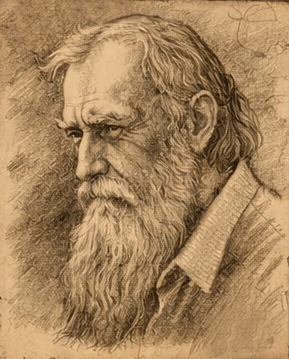
Author, Thornton Sumner takes publishing world by storm with new novel, BATU: Wings of Providence.
Thornton Sumner, first time author and native to Washington, appears to be the latest sensation on the publishing scene with his first novel, BATU: WINGS OF PROVIDENCE.
Despite its inauspicious birthing pains of being passed from one publishing house to another for three years one it finally reached the shelves merchants had a hard time keeping it there. Across the nation, orders cannot be filled fast enough as sales explode at an alarming rate, while instantly and firmly establishing Thornton Sumner within the world of modern literature.
The Seattle Sun was the first to catch up with the reclusive author and granted an interview. As I prepared my notes for the upcoming meeting I thought I had a good feel for the material and its author, but no amount of research could have prepared e for the man that emerged over hot coffee within the lounge of the Seattle Sheraton Hotel.
When this paper initially contacted Mr. Sumner asking for this interview, the author was reluctant and a bit gruff. But the elderly man I finally met was a gentleman from an earlier age’ a bearded giant with an easy smile and frenetic mind. His gruff baritone voice softened by the twinkle in his eye.
SUN: So, starting with obvious question, where did the idea for BATU come from?
SUMNER: I bought a woman from a Grek fisherman who told me she was Calipe, rumored to have been the muse of Aeschylus.
SUN: Uh… okay.
SUMNER: I keep her chained up in the basement.
SUN: Did you declare her passing through customs?
SUMNER: Oops. (laughs) Do you think it’s too late? No, really my gateway into the world of BATU is the same one the reader takes. It began with the yara. That’s the birth song for each member of the tribe. I read an article about a tribe in east Africa whose births begin not at the physical birth or conception but rather when the mother first thinks about having a child. Then she composes a son that becomes associated with the child for life. I loved that. Tha was the beginning for me.
SUN: You make it sound easy.
SUMNER: Ideas are relatively easy for me. Most are born from good research, but what is the most fun for me is creating new ideas from seemingly nothing. That’s where Calipe comes in (he winks).
SUN: Speaking of good research, I was told that you insisted on undergoing many of the events you wrote about before writing your final draft
SUMNER: Not by a long shot, really. Yes, I firmly believe in the value of being as authentic as possible. Going to equatorial Africa, for example, was vital. I had to feel the soil and breathe the air… You get my drift. And working with the tools and eating the food was also essential. But there are more things I didn’t do than I did do. No animals were harmed in the making of this book.
SUN: A disclaimer?
SUMNER: Precisely… Except for the leather-bound editions of course.
SUN: Of course. Now, you’ve been compared to Kipling and Tolkien, does that bother you? And who are your inspirations as an author?
SUMNER: I grew up on Kipling and take that as a compliment, but I think any similarity is merely a superficial genre likeness. To me they’re apples and oranges, but I don’t mind the comparison.
SUN: And Tolkien?
SUMNER: Beyond the attention to detail and the thoroughness of creating an entire fictional world from the ground up, I see no real similarity. But again, I don’t mind the comparison. I especially wouldn’t mind the success Tolkien achieved, but I think our current zeitgeist would not support such a phenomenon.
SUN: So, who would you liken yourself to, and who inspires you?
SUMNER: Well, first I have to make a confession: I’m not even sure what my genre is. I’m told that I’m historical fantasy, whatever that means. But I never read a book in a genre like that. Tarzan? Maybe Burroughs and I are fictional kinsmen, but again that doesn’t feel right. I never read Clan of the Cave Bear… I really didn’t think along those lines as I created BATU. I was, in fact, drawn to the material because it was completely alien to me. My inspirations were from completely different genres. Mark Twain, Robert Louis Stevenson, Jack London, Hermann Hesse, Frank Herbert, Goethe, Alan Watts, I can go on and on. But of course, if you want my immediate sources, you need only refer to my bibliography.
SUN: I have. Several hundred titles – it could be its own book.
SUMNER: (laughing) Yes, I think that will be my sequel, BATU: The Bibliography. But I’m a firm believer in good research. The Devil is in the details, so they say.
SUN: Just now you joked about a sequel but are you actually planning one?
(Sumner gives me a wry look and squirms in his seat)
SUMNER: I believe my coffee
is cold. I wonder what a man must do to get a fresh cup in this place.
SUN: I see.
SUMNER: Look, in writing a book like this you are constantly being bombarded with ideas that, though very good, just aren’t right for the current story. So fi you must know, yes, I had the idea for a sequel within my first two months of writing. I also wrote out a complete chronology providing the Batu with both a history and a future. The story in this book is the story of Mogai, who doesn’t appear until rather late and in a relatively boring period in BATU history.
SUN: Boring? Your readers don’t seem to think so.
SUMNER: Yes, thank goodness. But the story of Mogai si not really about the BATU, it’s the story of an individual and his internal world rather than the external one.
SUN: Are you Mogai?
SUMNER: Ouch! No, I knew that would come up eventually. It’s expected I suppose because the narrative follows Mogai so intimately. He does, of course, have elements of myself within him. How could he not All the characters do. But no, I don’t see myself as Mogai. Thank God. Would I put him through all that I did if I were him? (chuckles) My life story doesn’t have any of the drama and pain Mogai’s does. I’m rather a dull person and I no doubt create such characters as an antidote for a common life.
SUN: Hmm. Me thinketh he doth protest too much.
SUMNER: Perhaps I do. But I think I’m more like Wanyana than Mogai.
SUN: You mean aside from your being male.
SUMNER: Yeah, aside from that. Wanyana is old and tired. She’s lived her life. She’s done what she was put there to do and now just wants to rest. That’s me.
SUN: So, no sequel then?
SUMNER: My, you are persistent, aren’t you? (laughs) I know this may sound funny considering this is my first novel, but I always looked at it as my swan song as well. But… that being said, I don’t rule anything out. Where is that coffee anyway? •
Milton Miller: