




Wings Of Providence
A flurry of rustling feathers from the mother bird joggled her nest as she took to the air with widespread wings. The nestlings she left behind were exposed to the damp chill of the morning mist, crying with small chirping lungs for the return of the warm downy protection of their mother's breast. But this was not the first time she had left them on brief stints for food, so there was no reason to assume she wasn't coming back as she always had.
And yet, this time was different. Days came and went, and their mother never returned. It soon began to look as though the chicks themselves might not be around much longer, their piping squeaks of hunger weakening by the day as they slowly starved. Stranded in the aerie high within their tree, one after the other, they began to die until only one little bird remained.
“This is all very sad that my brothers and sisters have died,” said the remaining bird, “but perhaps it was for the best since their deaths have now given me something to eat.”
The bird ate then from the bodies of the other nestlings around him.
“This was surely meant to be so that I might live,” sang the bird with joy.
But when he'd finished eating, he found he was again without food, and it wasn't long before hunger took hold on him once more. Desperate to get to the ground and find more food, he was working his way out of the nest to climb down the tree when he slipped and fell. Thrashing his wings in panic, he was halfway to the ground when he learned he was able to fly well enough to safely land.
“I can fly!” he proclaimed as he touched the ground. “If my mother hadn't died, and if I hadn't got hungry again and slipped from the tree, I would never have discovered I possessed such an amazing gift. This was all meant to be so that I might learn to fly.”
The little bird truly believed he was the center of creation where everything that happened to him was orchestrated to protect and guide him as his divine purpose slowly unfolded. But now that he was on the ground and remembered his hunger, he realized that he didn't know how to find worms or where to look for them. Once again, he found himself on the verge of starvation.
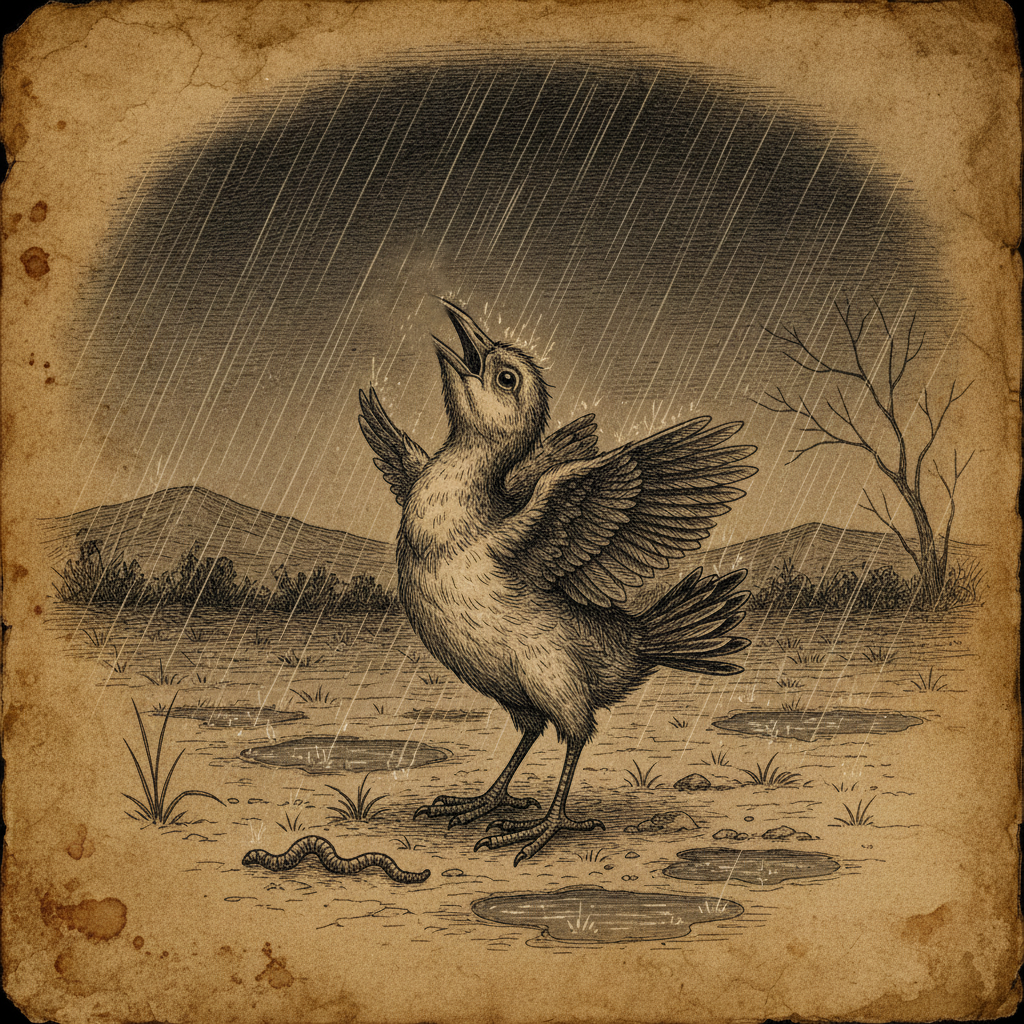
Eventually, it began to rain, and the little bird became cold and miserable. So miserable that he even began to doubt his sense of being special and looked out for. His mother was not there to teach him how to dig for worms, so he had no idea his food was right there beneath his feet the whole time. But he soon noticed worms were just appearing around him as they crawled out of the ground to keep him from drowning in the rain-soaked earth.
The bird raised his wings and head into the downpouring rain and sang a song of praise to the gods, those gods who once more provided to save his life.
“The rain brought me food!” sang the bird with joy as he began to eat a worm at his feet. “This is surely how it was meant to be. If the events of my life were not just as they were I would never have fallen and learned I could fly and that my food would simply appear when it rained. I can see now that when bad things happen it's to reveal great things to me. Everything happens the way it must happen because it's all meant to b

Making Friends
There once was a little frog who had a terrible time finding friends. He was a nice little frog, though perhaps a tad sensitive, and the boisterous croaking and rambunctious antics of the other little frogs tended to set him on edge. So, the little frog became somewhat solitary, avoiding for the most part the society of other frogs.
Now this little frog’s father was a proud and popular frog who had many friends and relations, and when Father Frog learned of his son’s propensity for solitude, he went immediately to speak with him to set him straight.
“This is most unnatural, this solitude of yours,” said Father Frog. “We are social creatures after all. Indeed, it may be said that a frog’s worth may be measured by his friends. Why, when I was your age, I was out making friends right and left, and I’ve been tied to each and every one of them ever since. You need to do the same and go out and make a friend this very day. For the tie that binds you to your friends today will prove to be the greatest source of strength and security in all your tomorrows.”
This was a long speech for Father Frog, who was normally a frog of few words. And the little frog idolized him as well, so it is safe to say that the words of Father Frog did not fall on deaf ears that day. The little frog promised his father that he would do precisely as he was told and set out immediately to do so.
The only problem was that the little frog had never made a friend before and he wasn’t entirely sure how to go about it. But once he set his mind to the task it wasn’t long before he hit upon the way he should begin. First, he would need a skeleton, and since he knew that a swarm of black ants would often leave bones in their wake after devouring their prey, the little frog went straight to the vicinity of a nearby anthill to see what he could find.
Sure enough, there were several piles of bones scattered around the base of the ant hill, and he was even lucky enough to find a complete skeleton about his size.
“It’s a bit larger than I,” said the little frog, “but I don’t suppose it would hurt to have a friend who’s a bit larger than myself.”
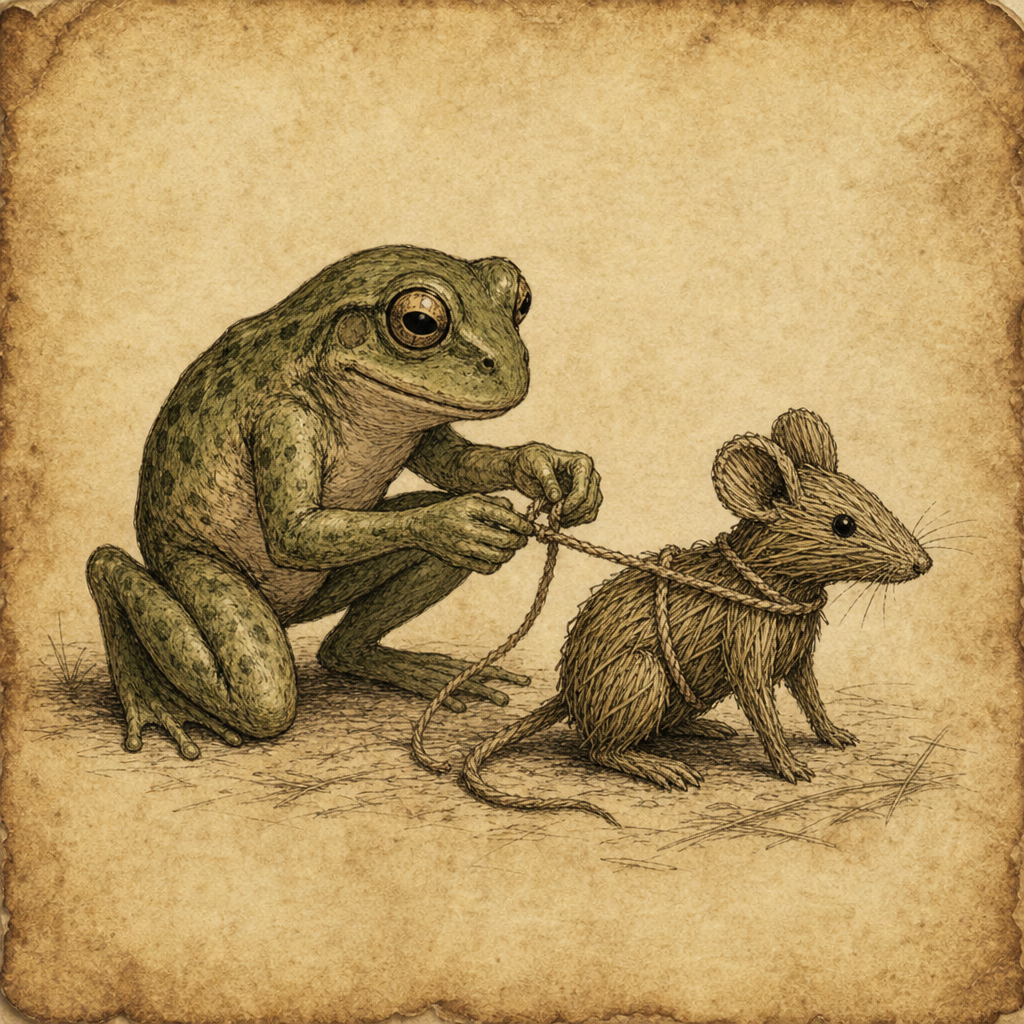
So, the little frog took the skeleton he had found and began patching it with mud and grass, fleshing out all the spaces and gaps between the bones until the creature that would be his first friend was completely made. Then without knowing why – though seeming perfectly natural at the time – he put his wide frog mouth to his new friend’s mouth and croaked into it, which immediately brought the creature to life.
Now, it should be said at this point that the new friend he’d just made was not really a frog at all, but a grass mouse. But being only a little frog, and not being very discriminating, he either hadn’t noticed, or he decided it didn’t matter. What mattered most to the little frog was that he was doing what Father Frog had told him to do and had made his first friend.
Recalling then everything else his father had said, he also went about tying a length of twine round the grass mouse while securing the other end around himself.
“Now we are tied and bound for life, as friends should be,” said the little frog to the grass mouse. “We will provide each other with strength and security for all our tomorrows.”
Thus, the little frog and the grass mouse were tied to one another so that they would never be parted. But because the grass mouse could not survive on both land and water like the little frog could, it wasn’t long before the mouse drowned.

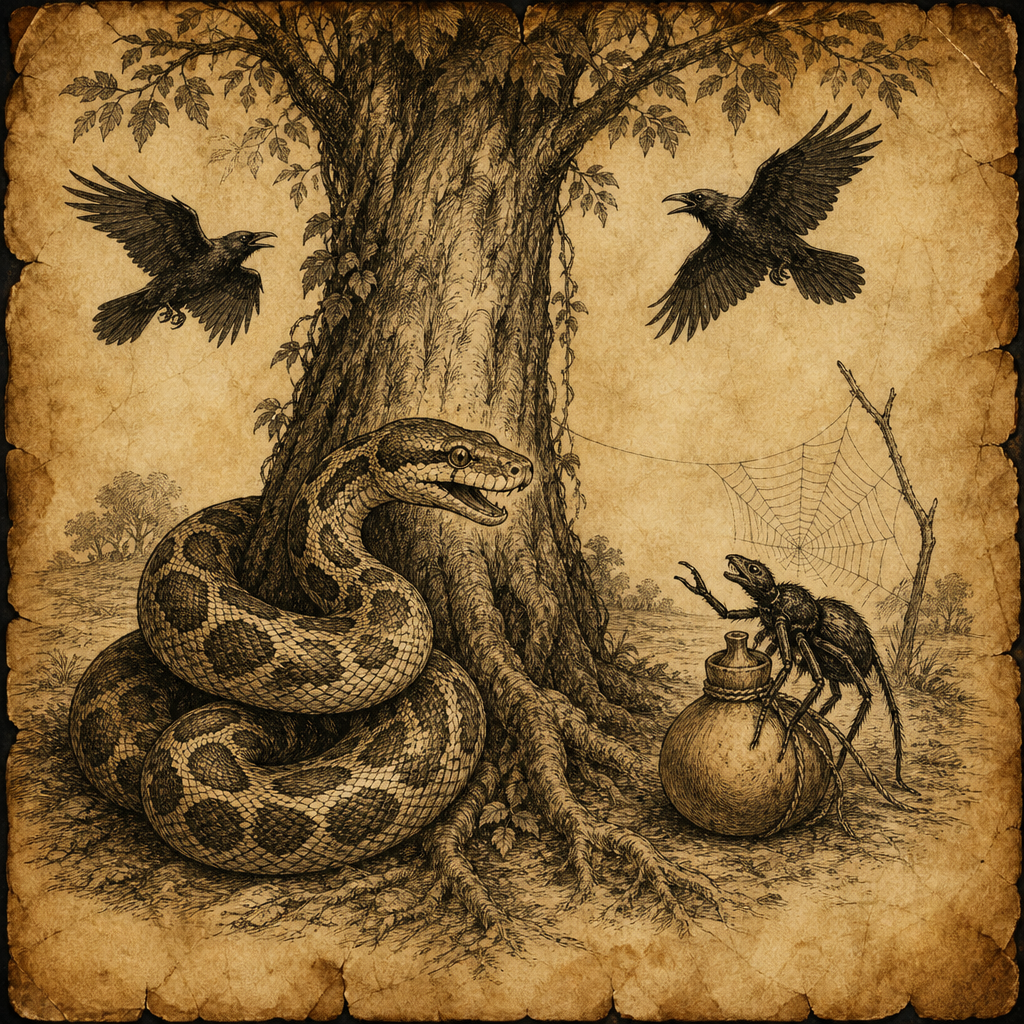
The Gourd of Wisdom
In the early days of the world, Fa – the goddess of divination – believed she was the only one who had an interest in wisdom. It became an obsession for her as she pursued it in all its manifestations. Every piece of wisdom that she ever found was priceless to her. Even the smallest insight became a pearl of great value. Knowledge, and learning how to apply it, was the only treasure worth pursuing for Fa.
But then she was told that she was not the only one who found wisdom useful, when Faro – one of her two raven heralds – informed her that there were mortals who walked the world in search of wisdom as well.
“This is awful,” said Fa. “How come I didn’t know about this?”
Having learned this, however, Fa was deeply resentful and becoming more and more selfish and greedy with the wisdom she collected. Wisdom was her passion, and she wanted it all for herself – every single bit no matter how big or how small. So, she sent her two raven heralds, Faro and Jaro, to the four corners of the world and had them collect all the wisdom there was to be found and place it in a large gourd.
Once the two ravens had completed their task, Fa knew that she had to hide the gourd of wisdom well so that no mortal could steal her priceless treasure. She had to put it somewhere where nobody could ever find it. She thought and she thought, but no hiding place that she could think of seemed safe enough for something as valuable as her gourd of wisdom.
Finally, in desperation, she sought the advice of her raven heralds, asking them if they had ever encountered on their travels a hiding place suitable for a treasure such as hers. It was Jaro who suggested that the safest place would probably be within the branches of the Omari tree – the great baobab tree that served as the world axis spanning the four realms of existence. Jaro reminded Fa that Gao – the giant python – was coiled round the base of the Obamti tree and would prevent all mortals from climbing into its branches.
“That’s perfect,” said Fa. “Why didn’t I think of that?”
When Fa arrived at the base of the Obamti tree with her gourd of wisdom, she looked up into its lofts and saw the many birds coming and going there within its branches. She suddenly began to have grave doubts about this plan. She did not like the idea of her valuable gourd left within the tree so that anything with wings might be able to pick and nibble away at her treasure.
Exasperated, Fa explained her frustration to Gao, coiled about the base of the tree. Being the guardian of the amori tree, it was natural for Gao to point out that if Fa were to manifest as a large spider, she could keep her gourd of wisdom safe by weaving large protective webs among the branches, shielding it from all the birds.
“Yes, that’s a good idea,” said Fa. “I should have been able to figure that out.”
Then picking up her gourd of wisdom, Fa began walking up the coiled length of the giant python, using its scaled back as a ramp winding up and around the Obamti tree. But when she finally reached the end of Gao’s tail and would have to start climbing the tree, Fa realized she could not climb if she needed both arms to carry the gourd of wisdom.
At her wits end, Fa cried out in despair to the sky above. There seemed to be too many obstacles between her and her goal, and all was doomed to failure. But then Shaba – the morning star – heard Fa’s song of woe and suggested that she sling the gourd over her shoulder by a strap, leaving her arms free to climb.
“That makes four times now that I’ve been aided by the wisdom of others,” said Fa. “Clearly, it is better when wisdom is shared than when it is horded. For despite having all the wisdom of the world in my gourd, it takes more than one person to properly carry it.”
So, though Fa went ahead and climbed up the tree with her gourd of wisdom strapped to her back, she made the branches of the Omari tree her seat of intuition from where she would redistribute wisdom back into the world.
In that place she manifested herself as a giant spider known as Ardra. And within her lair high up within the branches of the great baobab, Ardra spun her web of destiny from where she sees far and wide across the world with her many eyes. No longer hording her treasure, Ardra now teaches mortals how to read the signs of divination, giving back as much as she can from her gourd of wisdom.

The Herald of Jukun
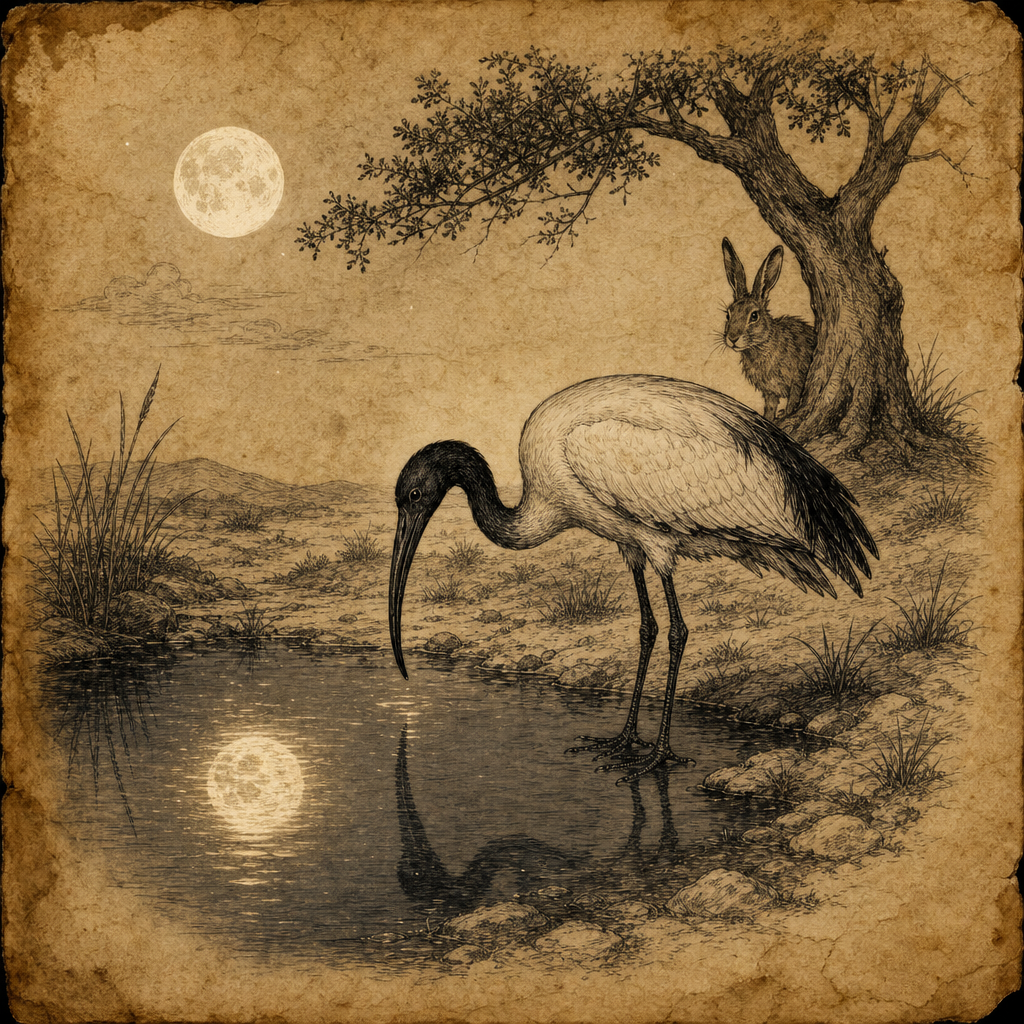
Long ago, in the early days of the world, there was a young ibis named Ijoka who was deeply enamored with Jukun, the moon. The young bird loved to fish at night, wading on long spindly legs in the moonlit pools of his marsh. Every night the face of Jukun was there smiling up at him from the surface of the pool where he fished, keeping him company as she cast the many shadows of darting fish.
But then with the passage of several days, the ibis noticed that the nights were growing darker and that the face of Jukun was waning within the pool. Alarmed by the idea that the moon was slowly drowning, Ijoka struggled for several nights to pull Jukun out of the water with its short beak, but with no success. It was on one of these nights that the white hare, Tapu, happened upon the pool where he witnessed the ibis in this heroic struggle.
“Whatever are you doing?” asked Tapu.
“I am trying to save Jukun,” said Ijoka. “As you can see, she is slowly sinking into the depths of the pool, but I am unable to lift her free. Please, I am in need of help, if there is any help to be had that could save her.”
Tapu considered this for a moment, wondering how he might best capitalize on the naivety of the young ibis. After careful consideration, Tapu told Ijoka that he must appeal to the Great Tree Spirit that inhabited the large tree in the center of the marsh.
“If there is any help to be had, it will come from the Great Tree Spirit,” said Tapu. “For it is he who has caught Jukun so many times in his topmost branches as she passes through the night sky.”
Ijoka was highly skeptical about this, for he had never looked up from his pool to notice that the moon travelled across the sky, and it seemed most unlikely that the Great Tree Spirit could help him retrieve Jukun from the pool. But then on the next evening when only a sliver of Jukun remained upon the water’s surface, the ibis relented and went to the large tree in the center of the marsh.
“Tree Spirit, O tree spirit, if spirit thou really be,” sang Ijoka to the tree. “I plead for your aid if there’s aid to be had, O please spirit speak to me.”
Being a young bird, it was not surprising that Ijoka failed to recognize Tapu the night before, though the white hare was renowned for being the greatest trickster the world had ever known. And at that very moment it was Tapu who answered the ibis, the hare being carefully concealed within the branches of the large tree.
“I am indeed the Great Tree Spirit,” said Tapu, disguising his voice. “Tell me what I can do for you, and I will tell you what it will cost.”
The ibis spoke to the tree then, telling it about his need to rescue Jukun from drowning in the pool. The Great Tree Spirit told Ijoka that it would draw the moon back from the depths of the pool if the bird would deliver fresh vegetables and berries for four days, leaving them at the base of the tree.
Ijoka was still skeptical but had little choice but to agree. He did what he was asked and delivered the vegetables and berries to the base of the tree and Tapu ate for free for four days. But the ibis got what he wanted as well as Jukun began to slowly reappear within the pool once more, waxing upon its surface.
No longer being skeptical of the Great Tree Spirit’s power, Ijoka returned to the tree and asked if it could foretell his destiny and relay what providence might have in store for him. The Great Tree Spirit said it would tell the ibis what he wanted to know if the bird would only deliver fresh vegetables and berries for another four days, leaving them again at the base of the tree.
Ijoka readily agreed.
Then after eating for free for another four days, Tapu spoke in the voice of the Great Tree Spirit, merely telling Ijoka what he believed the ibis wanted to hear. He said that the bird was destined for greatness and that he would be exalted above all others of his kind for having rescued Jukun from drowning in the pool.
Unbeknownst to Tapu, Jukun had been watching from above the whole time this farce had been playing out. She was well acquainted with the tricks of Tapu and decided to play a trick of her own while at the same time one-upping the great trickster.
So it happened that Jukun came upon Ijoka and fulfilled Tapu’s prophecy by making the ibis her herald, in gratitude for having saved her from drowning. From that day on the ibis was given a long down-curved bill in the shape of the crescent moon, to aid him in his task of pulling her free from the pool’s depths every thirty days.

The Weakening
Tapu, the prince of hares, was out foraging among the hills one morning when he noticed that his favorite patch of grassland was trampled flat and barren of all its roots and tubers to eat. Exploring further, he discovered that many of the other hares that lived within The Land of a Thousand Hills were also distraught by their destroyed grasslands, their food ripped out of the earth that was smashed in with tracks leading off toward the distant jungle.
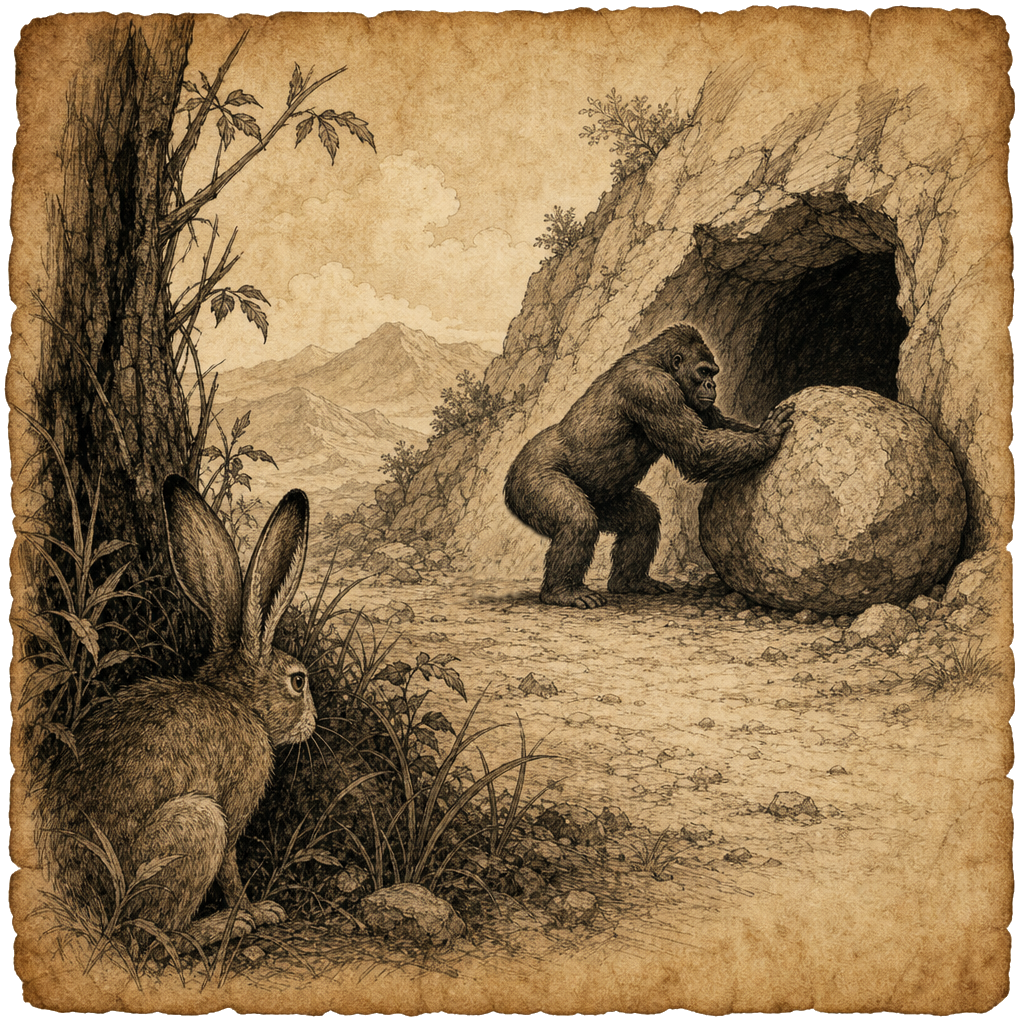
Consumed with outrage, the infamous white hare set out at once in search of the culprit. He followed the tracks that led deep into the jungle, and what he found there within a clearing overwhelmed his senses. He found an enormous hairy gorilla eating from a large pile of his people’s roots and tubers, crushing them to a pulp in his massive hands before filling his mouth. The beast’s size and strength were daunting, and he was devouring that which belonged to The Land of a Thousand Hills as if he himself were the lord of the land.
Tapu withdrew by reflex and in fear at the mere sight of such a savage. But feeling ashamed of this retreat, the white hare vowed to return and somehow rid his land and his people of this terrible threat to their resources. Tapu was the greatest trickster the world had ever known, and if there was a way for it to be achieved, he would find it.
Returning to the clearing deep within the jungle, Tapu remained concealed there, watching the giant gorilla as it finished eating. He followed the beast then to its cave where with one hand the gorilla rolled aside a gigantic boulder that was blocking the entrance. The white hare watched in amazement at the ease in which it rolled the massive stone aside.
Tapu decided that due to the beast’s great strength he should wait until it was fast asleep before employing whatever trick he might come up with. But before falling asleep the gorilla sealed the entrance to its cave with the boulder. That night Tapu tried with all his might and wiles to roll the huge stone, but it would not budge. He even chewed through and felled a small tree to use as a lever, but it was of no use. Tapu was riddled with frustration.
“This beast is just too powerful to manage!” cried Tapu.
For days, he considered how he might deal with the giant gorilla and the threat it posed to The Land of a Thousand Hills. And for days the monster continued to ravage the grasslands. Then one day when the white hare came upon a smaller female gorilla foraging by herself in the jungle he was suddenly struck with inspiration.
“I now know how to bring down the wild beast,” Tapu said.
The white hare gathered a mass of vegetables, which he used to entice the female gorilla, leading her to the sealed entrance of the monster’s cave. He left the pile of vegetables there for her to eat, which she did as she sat near the giant boulder. It wasn’t long before the savage male gorilla emerged from the foliage with its arms loaded with roots and tubers.
“What are you?” the male gorilla inquired.
“I’m a female gorilla,” she replied. “Don’t you know what a female is?”
“I have never seen a female, but I have heard,” said the gorilla with a growl as he approached her.
He then seized the female and mated with her there on the ground in front of his cave. When he was finished the beast felt drained, the female watching him as he ate only a small portion of his roots and tubers. When he was done eating, he struggled a bit as he dragged the female into the cave with him, straining then to roll the boulder to seal his cave for the night.
The next day the gorilla was exhausted, and when he returned to his lair with only a few roots and tubers, he once more ate very little and spent the whole night enjoying the female gorilla.
The next morning, he felt so drained and weak he was unable to move the boulder blocking his cave, leaving him forever trapped within his own lair.
Tapu returned home to The Land of a Thousand Hills and told all the other hares that the beast that had ravaged their
lands would no longer be a problem. When his people pressed Tapu to tell them how this was achieved he would only respond that every male, big or small, had the same weakness.

Tapu Steals the Sun
Long ago there came a time of darkness when all the world was compelled to live out their lives by the pale light of the moon. This inexplicable age of darkness continued until finally the white hare, Tapu, heard rumor that the light of the sun was now being hoarded by the mighty lion, Amadou.
Amadou was in fact none other than the worldly manifestation of the sun itself, a golden lion with a radiating mane whose terrifying roar scatters the herd of stars from the sky each morning. It is said that the sun is but the creative eye of Amadou, and that the great cat is the embodiment of divine power made into flesh.
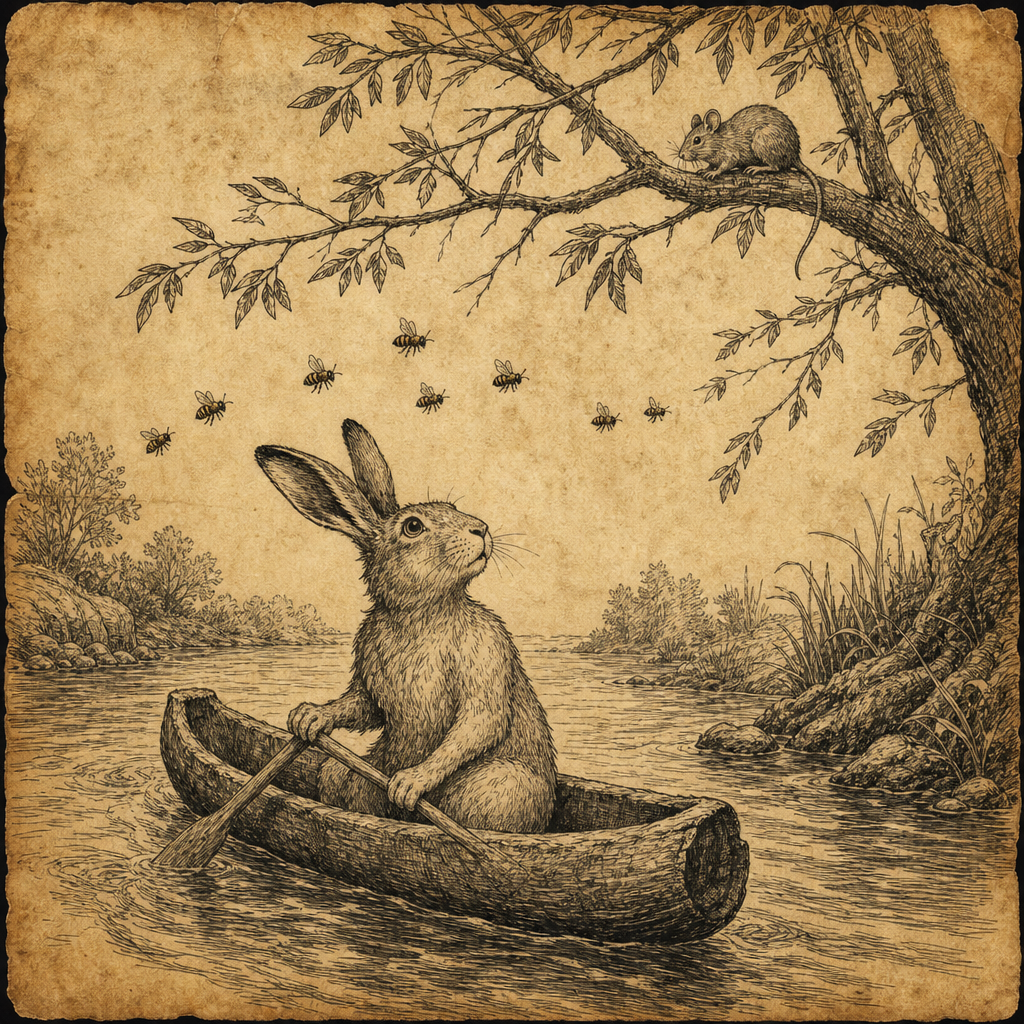
Nonetheless, when Tapu heard about Amadou keeping all the light to himself, the hare vowed to retrieve the sun so that all may benefit and the world would no longer live in darkness. So it was that Tapu fashioned himself a canoe and set off at once down river by the dim light of the moon, heading south toward the distant realm of Amadou.
It wasn’t long before a dark cloud appeared, moving out from the shadows of the riverbank toward his canoe. It was a swarm of angry wasps and they petitioned Tapu, requesting to join him in his quest to retrieve the sun.
“How might you be of help?” asked Tapu.
“If there izz to be a fight you will find uzz mozzt uzzeful,” buzzed the wasps. Tapu welcomed them and the angry swarm flew with him down the dark river alongside the canoe.
When they approached the dark outline of an overarching branch suspended above the river, Tapu heard a little voice coming to him from the limb. “I heard of your quest, oh clever Tapu. I wish to join and help all of you.” Tapu recognized the voice as being that of a mouse, perched there on the branch overhead.
“And how might you be of help?” asked Tapu.
“I can sneak and I can peek. I can spy on the Creative Eye,” said the mouse. “Oh, you’d do well from what I could tell.” Tapu agreed and welcomed the mouse aboard as the canoe passed beneath the branch.
It wasn’t long before another shadow cast by the moon fell across the travelers, a hawk swooping down to light upon the prow of the canoe. “When you find the sun, it is I who can help you carry it back into the sky where it belongs.” Tapu agreed and was glad to have him as they all continued down the dark river together.
The travelers drifted silently down the moonlit river for a long time until finally entering the southern realm of Amadou, coming then at last to the lion’s lair along the riverbank.
Once ashore, the others remained by the canoe as Tapu went first to confront Amadou alone in an attempt to reason with him. So, the white hare stated openly that he was there to retrieve the sun for the benefit of all and asked the lion if he would release it back into the world. But it was late and Amadou told Tapu to come back in the morning when they could discuss it with fresh minds.
Tapu returned to his friends by the canoe and told them what was said and sent the little mouse back in to spy on the lion.
When the mouse quietly slipped into Amadou’s lair, he immediately saw that the lion was agitated and talking to himself as he paced back and forth from one side of his cave to the other. “That foolish hare! To think I would just hand over the sun,” Amadou was saying. “I’m aware of Tapu’s tricks, and I don’t trust him one bit. I must handle this just right in order to be rid of him.”
Creeping among the shadows of the cave wall, the little mouse discovered there a covered pot that was extremely hot and seemed to glow from within. He reasoned that the pot must be where Amadou was hiding the sun.
“That Tapu is resourceful and will never leave without the sun,” said Amadou to himself, the lion continuing to pace back and forth. “And even if he did leave, he would only keep coming back until he tricked me somehow into giving him what he wants. So, I will just have to eat him for breakfast and be done with him forever.”
The mouse scurried back to the canoe to tell Tapu what he had heard. Once the others learned what the lion intended to do, the dark shape of the hawk immediately took to the air and flew straight into the cave. By the time the others were able to turn toward the lion’s lair they were looking right into the light of the sun from the uncovered pot flying straight toward them. They all ducked just in time as the hawk passed overhead carrying the pot of sunshine in its talons.
Tapu launched the canoe at once with the mouse and wasps as they all set off upriver. They cringed in fear then from the roar of Amadou’s anger as the lion charged from his lair to pursue them.
The wasps gathered into a large dark cloud and buzzed, “We have come to fight and now it izz out turn.” And with that, they flew back and enveloped the pursuing lion like a billowing storm. Amadou burned and killed many of the wasps, but in the heat of battle the others were able to escape and retreat to safety. The remaining swarm of wasps soon caught up with Tapu’s canoe, and they all eventually made it back home just as the hawk was pouring the sun from its pot to light the sky. Thus, Tapu had succeeded in returning to all the creative power of life.

Jabwe and Walumbi
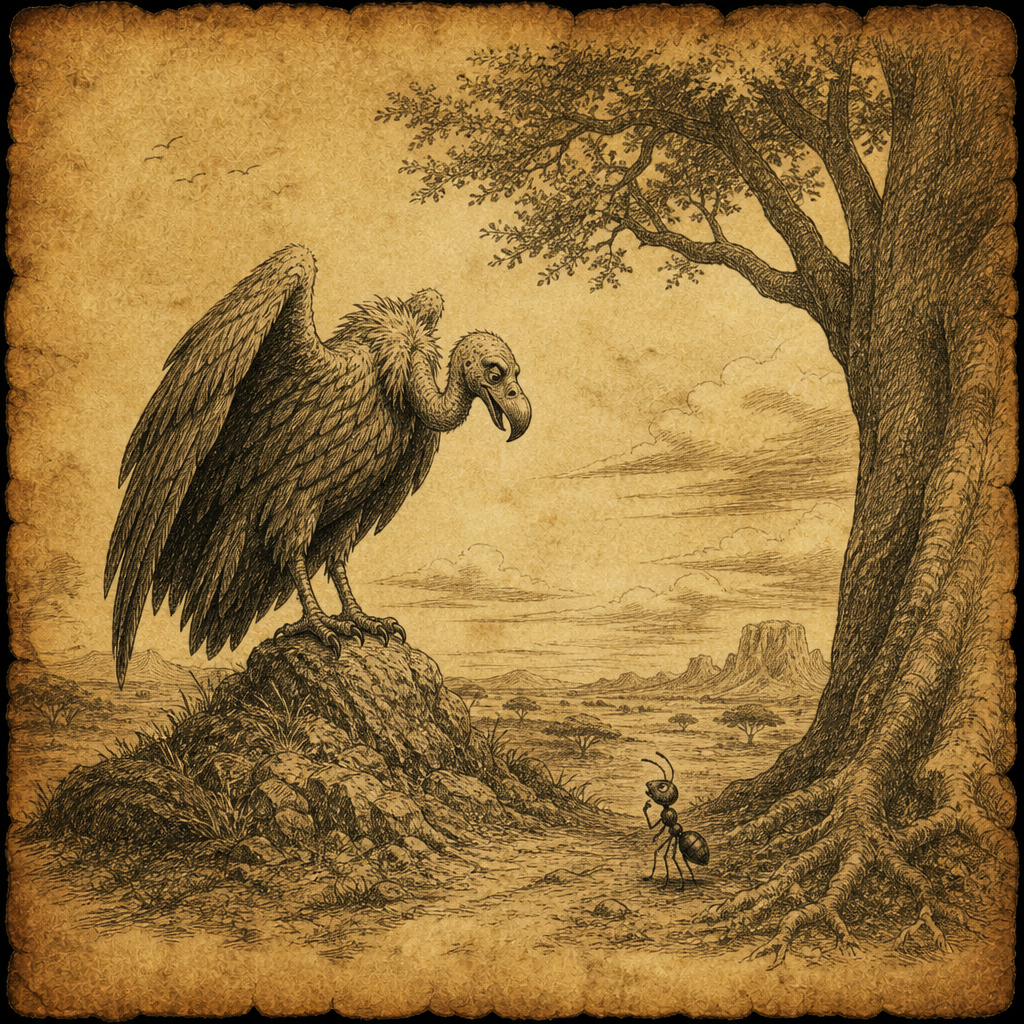
From the very earliest of times, Mabolo, the goddess of death, had sent her herald, Jabwe, the vulture, into the world of Vaal to collect the dead and guide them on their way to the underworld of Alodia. This was why vultures were always seen circling overhead, as Jabwe searched for those who might be on death’s door. But life never gave up its hold willingly, leaving the vulture destined to wrestle with every organism upon the face of Vaal. If a creature could overcome Jabwe it would be allowed to continue as it had until they met again. If not, its life would be forfeit and had to follow him into Alodia.
Until one day, Jabwe was passing the time in conversation with a soldier ant, the two of them discussing various grappling techniques for single combat. As they went on with their conversation the worker ants were going about their business of digging tunnels in the earth and working their way to the very core of even the largest trees.
As the vulture was preparing to move on, the soldier ant stopped him to say, “Jabwe, you are indeed a formidable wrestler, but you should not be asking about my tricks of combat. You would do better to learn the way of my worker brothers here. As a soldier I fight but one opponent at a time, as you do. Whereas my brother work in unison as a single organism, digging their runnels beneath the earth and within the very heart of every tree. They remain out of sight, and their work goes unseen, but they bring down the mightiest and the largest edifice every time without fail.”
After Jabwe relayed this to Mabolo, the goddess of death immediately implemented this technique of the worker ants. Thus, Walumbi was born – the ant manifestation of death. Rather than attacking and challenging life in open combat, as Jabwe does, Walumbi is sent as the little death who attacks from within – the rot and decay that eats away at life from the inside-out.

Bitter Ends
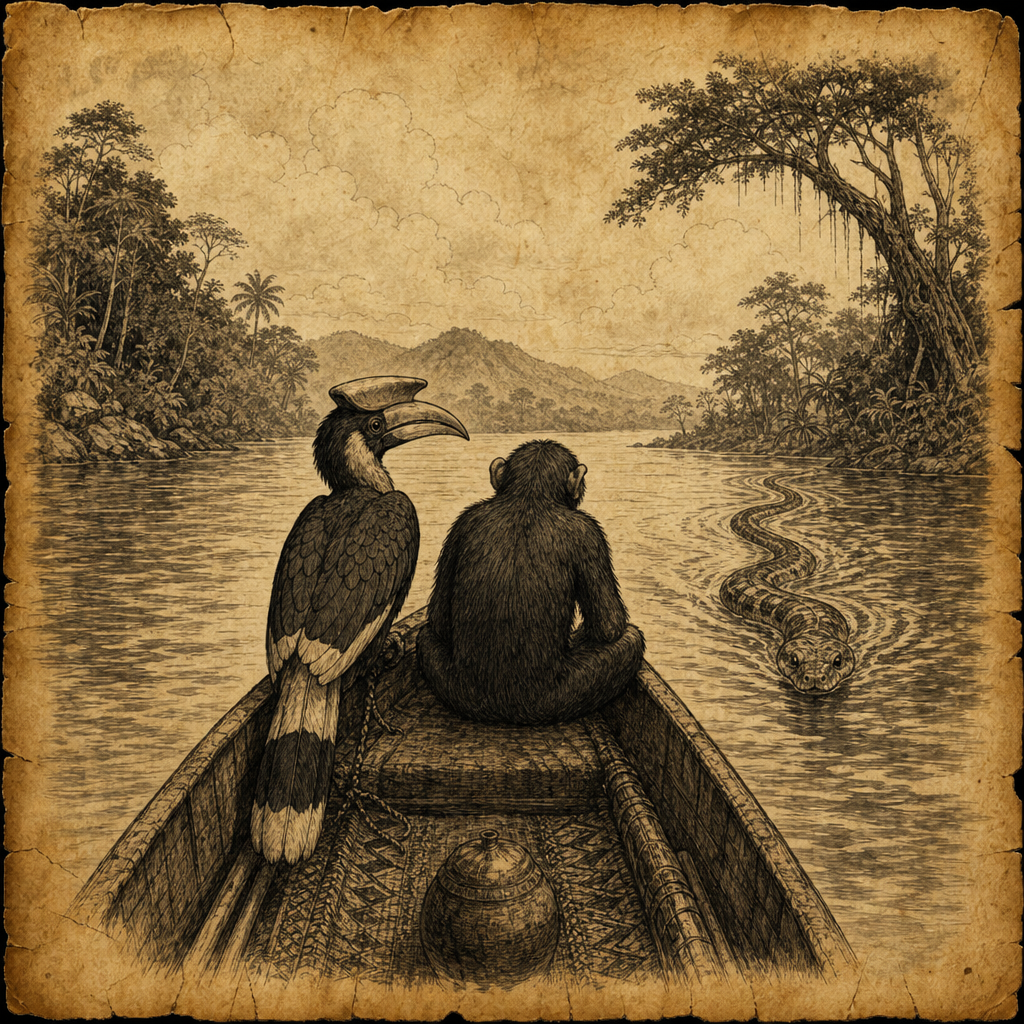
A hornbill died and flew to Mabolo, the goddess of death, landing in her pirogue as she paddled down the River Po.
“I suppose this means I’m dead,” the hornbill twittered.
“Yes. I will deliver you to the underworld now,” replied Mabolo as she paddled on down the river. “But the River Po is long, and I would be interested to hear what you thought about your life while we travel together to Alodia.”
“I had a good life,” squawked the hornbill. “It was a life full of flight and song, warmth and joy. But…”
“What troubles you, child?” Mabolo asked the hornbill.
“Well, it’s how I died. I was singing as I usually do, singing my praises for all creation. I just can’t help myself when the spirit of music moves me. But then a chimpanzee snuck up on me while I was lost in my music and ate me. Is it right that I should die for doing what I was born to do?”
“Don’t fret, child,” replied Mabolo. “I will call the chimpanzee now so you may learn his part in this.”
Then with a blink of Mabolo’s large, solitary eye set within her forehead, a chimpanzee swung down from the jungle lining the river Po and landed in the pirogue with the hornbill as Mabolo continued to paddle.
“Does this mean I’m dead?” the chimpanzee asked.
“Yes. I will deliver you to the underworld now,” replied Mabolo as she paddled on down the river. “But the River Po is long, and the hornbill and I would be interested to hear what you thought about your life while we travel together to Alodia.”
“Oh, it was a lot of laughs,” the chimpanzee chattered excitedly. “Full of games to play and good food to eat. Food that sang out loud and clear so that I might easily find and eat it. But…”
“What troubles you, child?” Mabolo asked the chimpanzee.
“It doesn’t seem right how it all ended. Everybody knows how much I love a good joke. Well, I was busy tying a large python into a knot, who I thought was fast asleep, when it turned and swallowed me whole. I was just having fun playing tricks and games as I was created to do. Is it right that I should die for doing what I was born to do?”
“Don’t fret, child,” replied Mabolo. “I will call the python now so you may learn her part in this.”
Then again, with a blink of Mabolo’s large, solitary eye set within her forehead, a python came swimming out from the shoreline into the River Po. It then slithered into the pirogue with the hornbill and chimpanzee as Mabolo continued to paddle.
“Ssso, isss that it?” the python hissed.
“Yes. I will deliver you to the underworld now,” replied Mabolo as she paddled on down the river. “But the River Po is long and the hornbill and the chimpanzee and I would be interested to hear what you thought of your life while we travel together to Alodia.”
“It wasss ssswell,” replied the python. “I wasss ssso beautiful, the envy of all who sssaw me. And the food! The food wasss ssso deliciousss. The food would walk right up to me at timesss and pull my tail asss if to sssignal it wasss time to eat. But…”
“What troubles you, child?” Mabolo asked the python.
“It’sss jussst that… Sssomething about the end of it jussst doesssn’t ssseem right to me. I had jsussst eaten a rather large meal, ssso I wasss moving a bit ssslow when out of nowhere an elephant ssstamped through, crushing me underfoot.”
“Uh-oh” the hornbill and chimpanzee muttered in unison as they glanced nervously about the already crowded pirogue.
“It jussst ssseemsss ssso unfair,” the python continued. “I wasss only living the way I wasss created to live. Isss it right that I should die doing what I wasss born to do?”
“Don’t fret, my children. And be at peace,” Mabolo said to all three of her passengers. “I will not be calling for the elelephant now so that we may learn his part in this. Mutanda must travel along a different road to Alodia. The River Po is not his path to the underworld. But I will answer you all now as I always do at this point. Every creature of the world lives and dies according to their natures that were given to them.”
Thus, it is said that when Mabolo is given to recall a particular soul in a particular place and time, she will call upon that creature’s own desires to lead them to her.

The Message
In the early days of the world, it was commonly believed that when you died you would be dead forever. This belief in a permanent death was cause for much misery and sorrow across the land. The world’s inhabitants built monuments of their grief as they mourned the loss of loved ones to no end, viewing their departure from the world of Mara as an eternal separation from life into oblivion.
The moon, Jukun traveled the night sky for untold ages, witnessing the needless suffering born of this belief, that one’s death was the one big ending to end all endings. Jukun, however, knew this to be false. Yet she alone possessed the fundamental truth, that there was no absolute beginning and that there would be no absolute ending. Jukun alone knew that anything that existed died and was reborn within every passing moment as it shifted though the passage of time. All was a process of change that never truly ended, and what was called death and birth were but distinctions of degree.
Having grown weary from watching the folly of the world for countless generations – watching the ceaseless displays of mourning brought on by this single mistake in belief – the moon, Jukun, finally resolved to send them all a message of truth. A message designed to set them free at last from their despair.
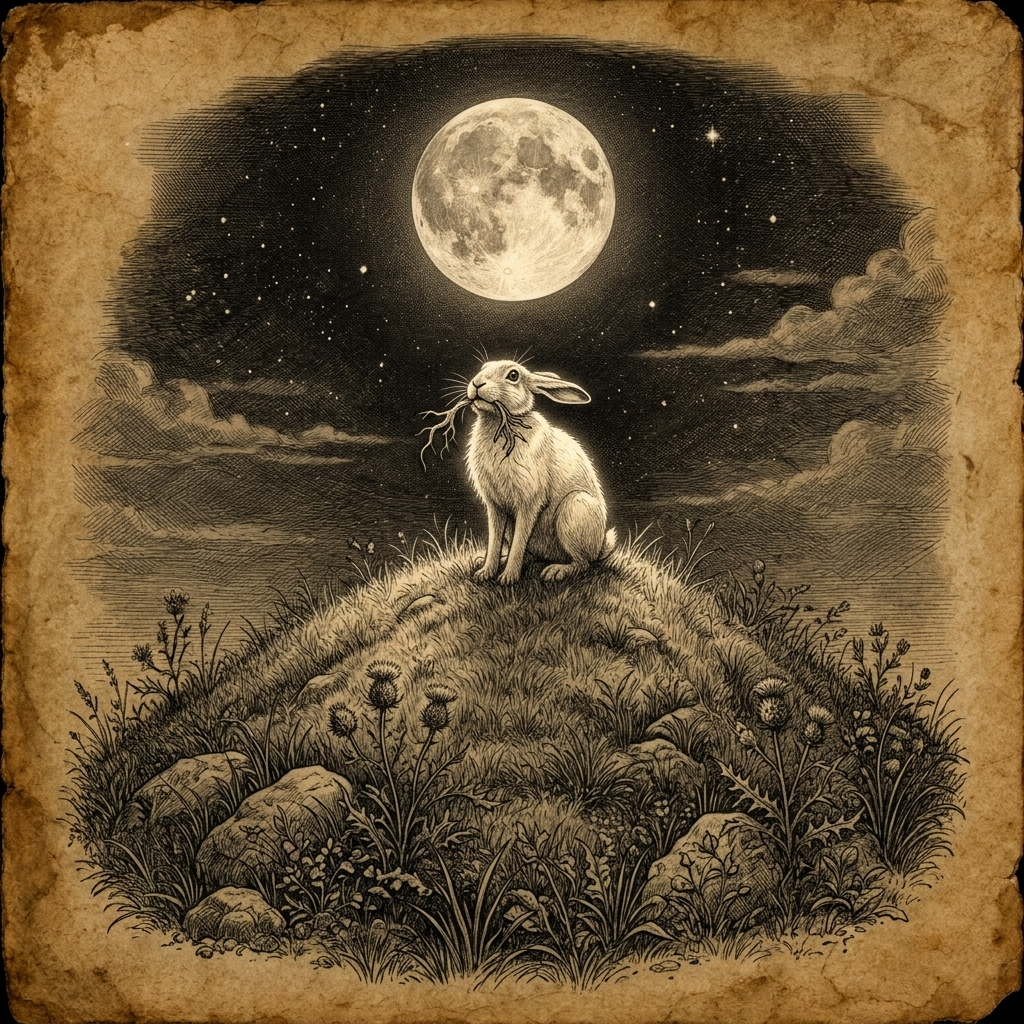
And so it happened that one evening when the full ace of the moon shone down upon the world of Mara, it eventually came upon the white hare, Tapu. Unable to sleep, Tapu was crouched alone atop a high hill as he dug for roots so he might feed. His white fur glowed within the full moon’s light as Jukun passed by overhead and when she spotted the notorious trickster, she immediately called upon the hare to deliver her message of truth to the rest of the world.
“For even I am subjected to die every thirty days only to be born again,” explained Jukun to Tapu. “So too in this way shall all life pass through death only to be born again in their own time.”
Tapu was distracted with his attention focused on his digging and the root between his teeth, but he promised Jukun that he would pass along her message to the rest of the world. Yet when the next morning came and Tapu remembered his promise to Jukun, he was suddenly struck by the magnitude of his task. It would be no small feat to pass along this message to every inhabitant of Mara. Yet he also knew that if he succeeded he would be rewarded with great honors and that he would be favored highly amongst the gods.
So consumed was Tapu by this wish for renown, he raced across the world as fast as he could in order to dispense with his task, his haste resulting with an unfortunate abbreviation of Jukun’s original message.
“Even as the moon, Jukun is subject to die,” explained Tapu to each inhabitant of Mara, “so too shall all life face death in their time.”
That evening when Jukun learned about Tapu’s distortion, and his utter failure to impart her message of truth, she became furious. The world of Mara was now in a state of heightened despair like never before, having received false confirmation that death was the one big ending to end all endings.
So, instead of rewarding Tapu with the honors he expected, Jukun inflicted the hare with a cleft palate, rendering hum mute so he could no longer speak falsely, or at all. In addition, Jukun extended Tapu’s ears to ridiculous proportions, saying, “Now you will be silent, and the fissure within your mouth will not heal until you learn how to listen.”

The Shadow of Damu
Among the hills of the grassy highlands there once lived a hare of great renown named, Damu. Legend had it that he was born at a run, straight from his mother’s womb, the largest and fastest in the litter. His ears and hind legs were both long and powerful. His eyes and nose were both pink and keen. He was both strong and swift. Damu was second only in greatness to Tapu himself, the prince of all hares who became Damu’s closes friend.
Damu was also endowed with an excessive appetite for procreation, unequaled by any other hare alive. His lust, however, found it match in his own excessive pride, which served to keep his hunger in check. For though Damu could have any doe of his choosing among the many forms of the highlands, he refused to settle for anything less than his due.
So, it happened that Damu spent all his days testing the does, giving chase to them through the many hills of the highlands. However, he caught them all so easily and quicky, pinning them by tooth and claw around the scruff of their necks, his lust was forever frustrated by the ease of conquest.
“These does are not worthy!” Damu would cry out in disappointment.
“Where is the challenge for which my gifts were meant to meet? These does are too common. A hare such as I requires the uncommon, the unique experience of mating with his equal.”
Thus, while Damu chased the does through the long grass of the hills, he never once found a doe that was not easily subdued.
Then one sunny afternoon, while in hot pursuit of another doe, Damu broke from the cover of grass out ito an open flat plain. Confused by the foreign nature of the broad open space, Damu ran in large circles upon the plain. He noticed there for the first time that another hare was keeping pace with him as he ran.
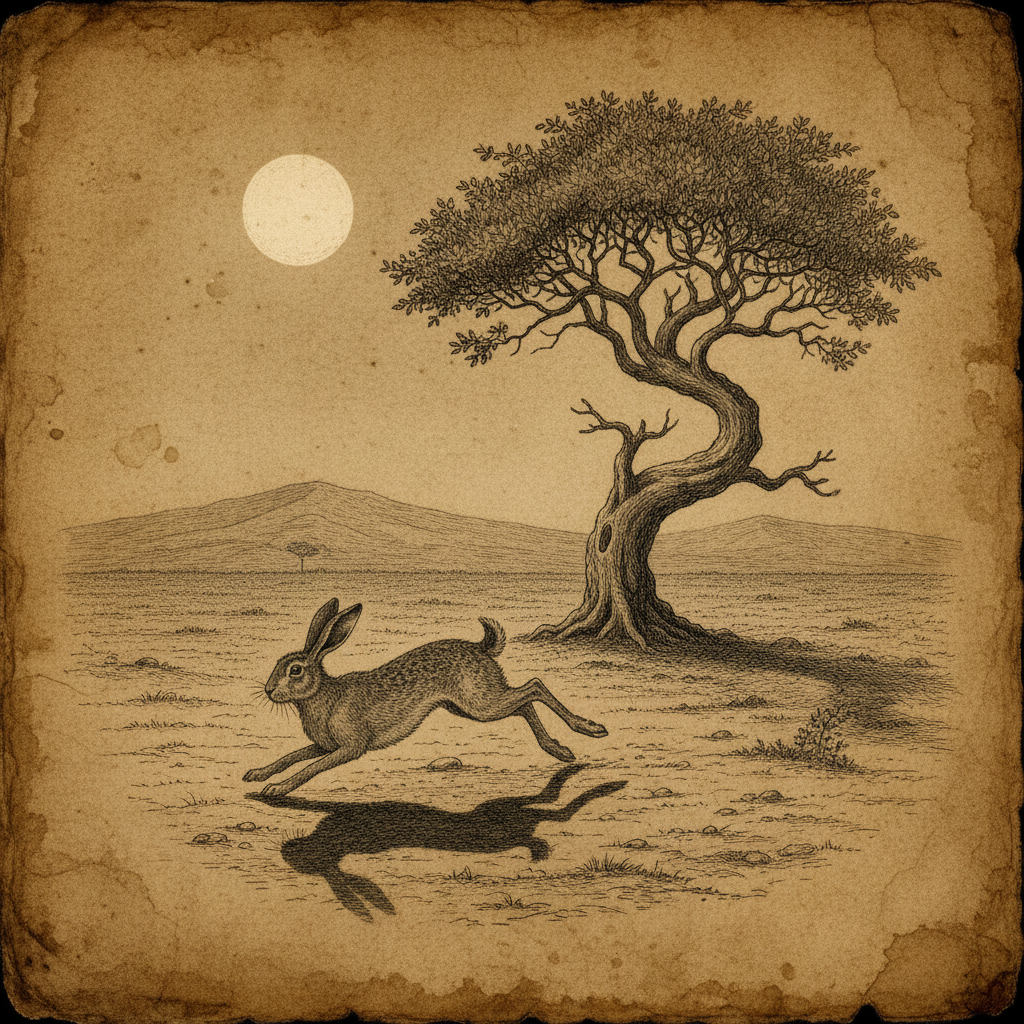
The strange black hare would grow and shrink as Damu turned first this way and then that way beneath Jumara, the sun. He had never seen his shadow before, and he mistook it for another hare. He pursued his quarry across the plain. It seemed he was always on the verge of catching it, but no matter how fast he ran, Damu could not catch his own shadow.
He was alarmed at first when he noticed his prey would always vanish when chased into the tall grass. But being a clever hare, he knew it must have doubled back to the plain at the last second, and sure enough, he’d always find it there.
So, it was then that Damu would spend his days chasing his shadow out on the plain. He finally found a mate worthy of his greatness.
Eventually he learned that his quarry was not so quick during the hottest phase of the day, when Jumara was at his highest point in the sky. At that time, Damu found he could mount the back of the black hare, and for the firs time he could finally deposit his seed.
When word of this spread, the other hares of the grassy hills descended one by one to the edge of the plain and watched in astonishment as Damu chased and copulated with his own shadow over and over again.
“Banyoro,” some had called him, meaning crazy or foolish. When less kind they would call him babido, meaning deviant. For many hares among the forms of the highlands were angry at such a waste.
“Damu is among the greatest of us,” said one. “Second only to Tapu himself. His Strength and speed of foot should have been preserved and passed on to out children. Instead, his seed will be left lying wasted in the dust.”
But it wasn’t long before the hares of the highland hills were spared from witnessing further the great waste of Damu. For, as it was his wont to spend all his days upon the open plain, it wasn’t long before the much larger shadow of Jabwe passed between Damu and the sun.
So, it was at last, within a swift flurry of large wings and flashing talons, that Damu and his shadow were both removed from the plain forever. All that remained of the greatness of Damu were the pools of his seed, a few drops of blood, and a tuft of fur blowing about in the warm breeze.

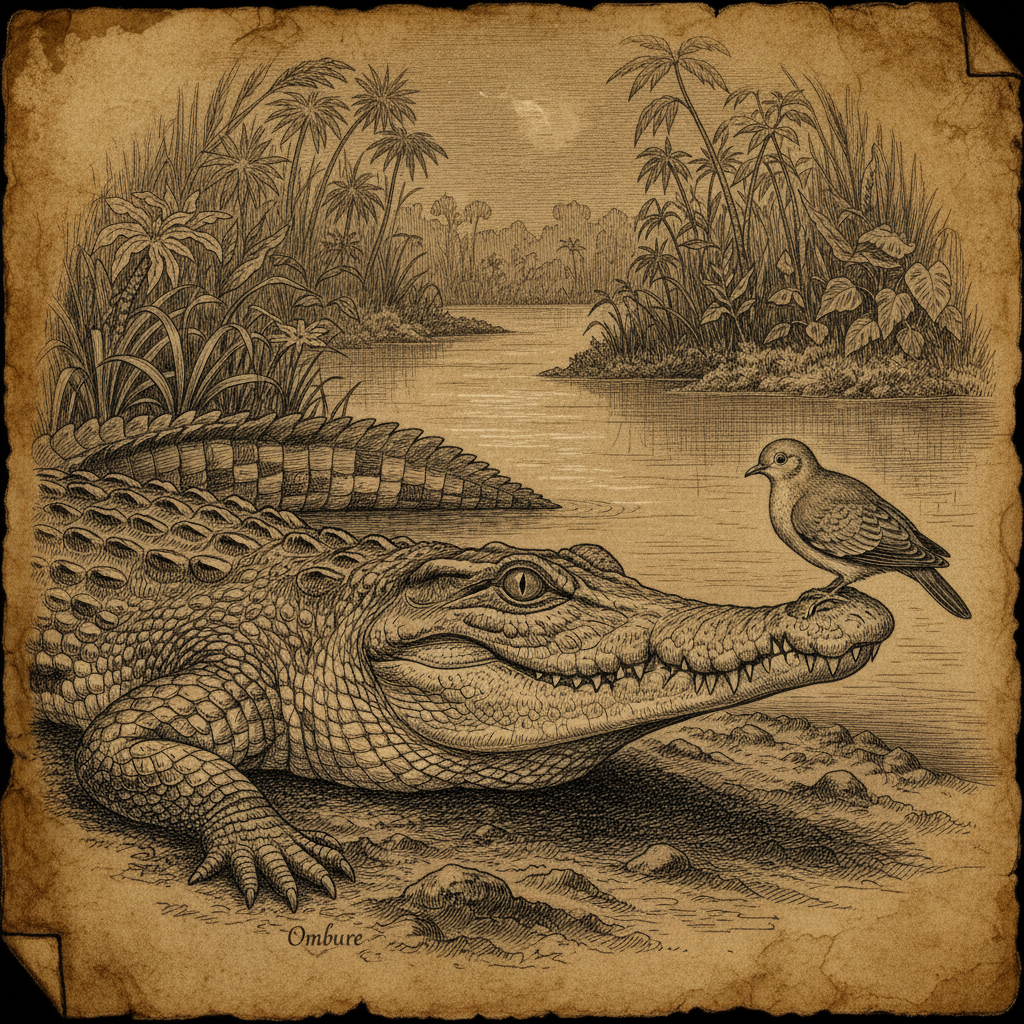
The Tears of Ombure
The great lord of the crocodiles, Ombure, was lying in the mud along the banks of a river one day when his friend the wood-dove came and landed on the tip of his long nose. The dove cocked its head at Ombure and asked him why he looked so down.
“Down?” replied the great crocodile. “Not everybody gets to fly through the air, don’t you know. I’ve only these stubby little legs that keep my belly in the mud most of the day. I suppose that may be why I look so down, as you say.”
“But you’re not stuck there, are you? You can move, can’t you?”
“Well, there is stuck, and then there is stuck. It is quite comfortable here you see, and in that sense, I am most definitely stuck my friend.”
“Yes, well idleness does sap the vigor of the soul. I should think you’d feel much better if you moved about a bit more,” said the dove.
With that, Ombure opened his large jaws and ate the wood -dove, saying, “Thank you, my friend. You were right about that. I do feel better now.” But it was a lie, the great crocodile didn’t feel a bit better.
Shortly, his friend the baboon swung down from a nearby tree to get a drink from the river, and upon seeing his good friend Ombure, he asked the crocodile why he looked so sad.
“We can’t all be happy and gay eating fruits and nuts all day, don’t you know,” answered the crocodile. “I’ve come to learn on this very day that my life is too idle, and that happiness and comfort are not the same thing after all. I’ve been told I’m wasting my life lying here in the sun along the banks of the river.”
“That’s nice,” said the baboon, not really listening. “But it just occurred to me, what you really need most is a sense of purpose. A creature without purpose is the most miserable creature there is.”
“Thank you,” said Ombure. “You’re a good friend.” And with that, Ombure opened his large jaws and ate his friend the baboon.
Then after a while Ombure’s friend the warthog came along and found the crocodile on the verge of tears, still flat on his belly in the mud.
“Whatever is the matter, my friend?” said the warthog to the crocodile. “Why the long face?”
“Oh, no reason really. It’s just that I’ve learned today my life is too idle, and that I’m unhappy and miserable because my life holds no purpose.”
“That’s not your real problem,” said the warthog.
“No? I should have known I’d be wrong about that as well,” said Ombure.
“Indeed,” said the warthog. “Those other things are secondary. The most important thing in life is friendship.”
“Friendship?” Ombure gasped. A sense of tragedy and anguish washed over him upon hearing this new revelation.
“Indeed,” said the warthog. “With friends, you can endure all your shortcomings. But without friends to share your ups and downs with, overcoming your shortcomings will mean nothing at all.”
The great crocodile began to weep.
Troubled by the tears of Ombure, the warthog asked, “Why are you crying, my friend? Is there anything I can do to help?”
“No,” the crocodile replied. “Just something I ate.”
With that, Ombure opened his large jaws and ate his friend the warthog as well. He’s been weeping ever since.

Turtledove Love
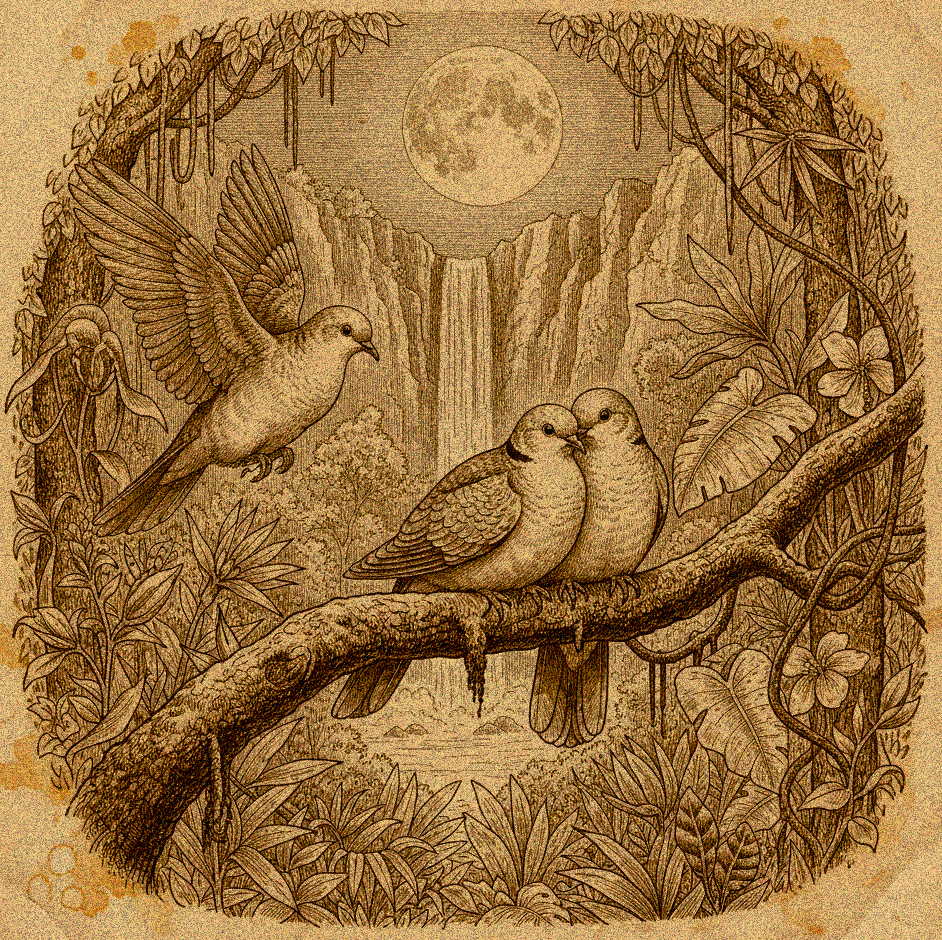
Jumara was setting, ending yet another day for a lone turtledove who sat perched upon a mossy tree limb singing his sad songs of loneliness. He gazed out through the jungle foliage upon a slip of a waterfall streaming down a distant cliff-side. He sang to his solitude as the moon rose above the distant cliffs, bathing the entire jungle in a wash of silver. It was a romantic scene, which served to inspire the turtledove’s crooning arias during his lonely vigil.
It wasn’t long before a female turtledove flew out of the night and joined him there on the tree limb, listening as he sang. Soon she began to sing along with him as they both slowly inched closer and closer toward one another. They sang that way, cuddled up together for so long the moon had walked its course across the night sky. Finally, the songs faded, leaving only the sounds of the waterfall, and as the rest of the jungle slept, they spent the rest of the evening cooing soft whispers of love to one another.
The two turtledoves were very happy and very much in love.
“I’ve never loved like this before,” said one to the other.
“I’ve waited my whole life for a love like this”, said the other in return.
They both agreed that this was the one true love that all turtledoves hope for and which comes but once a lifetime, and then only with luck.
When Jumara began to rise for a new day the female turtledove turned and said, “I must go now my love, but I will return to you tonight when Jumara sets once more. I will follow the sound of the falling water and listen for your songs of love.”
With that she departed and his heart was as light as air as he watched her fly off into the rising sun.
It was the longest day of his life as the turtledove waited for Jumara to set so his one true love would return to him. He was so eager tor his love, he began singing as soon as Jumara came even close to the top of the distant cliffs. He drowned out the sound of the waterfall and sang with all the new love that was swelling within him. It seemed as if he had been singing for ages when Jumara finally began to crawl behind the distant cliffs.
The turtledove almost fell from the moss-covered tree limb in alarm when the feminine whistling of a turtledove right beside him joined his tune in perfect harmony. He did not hear or even see her approach this time, but his alarm was exchanged for shear joy to see her then. He began singing again with gusto and pride, quickly hopping up beside her to nuzzle his head to hers. He felt her draw back a bit as if taken by surprise herself now. But she soon found herself carried away in the music once more as they twittered and chirped their entwining love ballad.
As the last rays of Jumara broke across the distant cliff top the turtledove felt as if he had fallen in love all over again as he began cooing whispers of love once more.
“I felt like I would die waiting for you. My love cannot go another day without you in it,” he said.
“I’ve waited a long time for a love like this too,” she said in return.
Then just as they began to cuddle together and resume their songs of love, a female turtledove flew out of the night in a flurry of angry feathers, interrupting their singing.
“What’s the meaning of this?” squawked the newcomer.
“We are falling in love, what is it to you?” replied the other female turtledove who was just interrupted.
“What is it to me?” came the now shrill pitch of the newcomer. “I’ll tell you what it is to me. I was with this same turtledove just last night as we spent the entire evening singing together under the moon, falling in love.”
With that, both female turtledoves stood apart and looked back at the male turtledove who was struck dumb with astonishment.
Side by side the two females’ differences were obvious, but by themselves he couldn’t tell them apart.
After several moment of furious squawking and pecking as both females set upon the stupefied male, they eventually took to the air, departing in separate directions into the night.
The now lone turtledove was utterly heart broken. He had waited his whole life for his one true love to come along and after finally finding her he lost her after only a single day. He wished he were dead. He began to sing then like he’d never sung before. He sung his hearts lament to the rising moon. He felt like such a foolish bird who doesn’t even deserve love. He vowed there and then that he would never love again. Ahe sag out loud and clear into the still night, his deepest pain laid bare for the entire jungle to hear.
The moon had not but taken a couple steps across the curtain of night when yet another female turtledove flew out of the darkness to land on the moss-covered limb beside him

Left Behind
The danger of Mutanda was real. That much should be understood from the start. The large bull had gored and crushed several in the herd before the coppered antelopes began leaping high into the air, scattering in all directions. It was as if the earth itself had erupted, the antelopes flying four times their height into the air with arched backs and lowered heads in a stiff-legged bouncing frenzy.
No one knows what angered Mutanda into his rampage, but the earth shook with the stamping of his feet, and the air filled with his trumpeting rage as he wetted his ivory tusks with the blood of those leaping his way in panic.
In truth, the herd did more harm to themselves by running than Mutanda ever would. Broken legs from stepping into soft earth, the trampled and kicked of the fallen in the stampede, the countless obstacles unseen in their erratic blind terror. Unable to run himself, merely attacking at a quick walk, Mutanda could match neither their speed nor self-destruction, but charged ever after in a cloud of dust, trampling the wounded left behind.
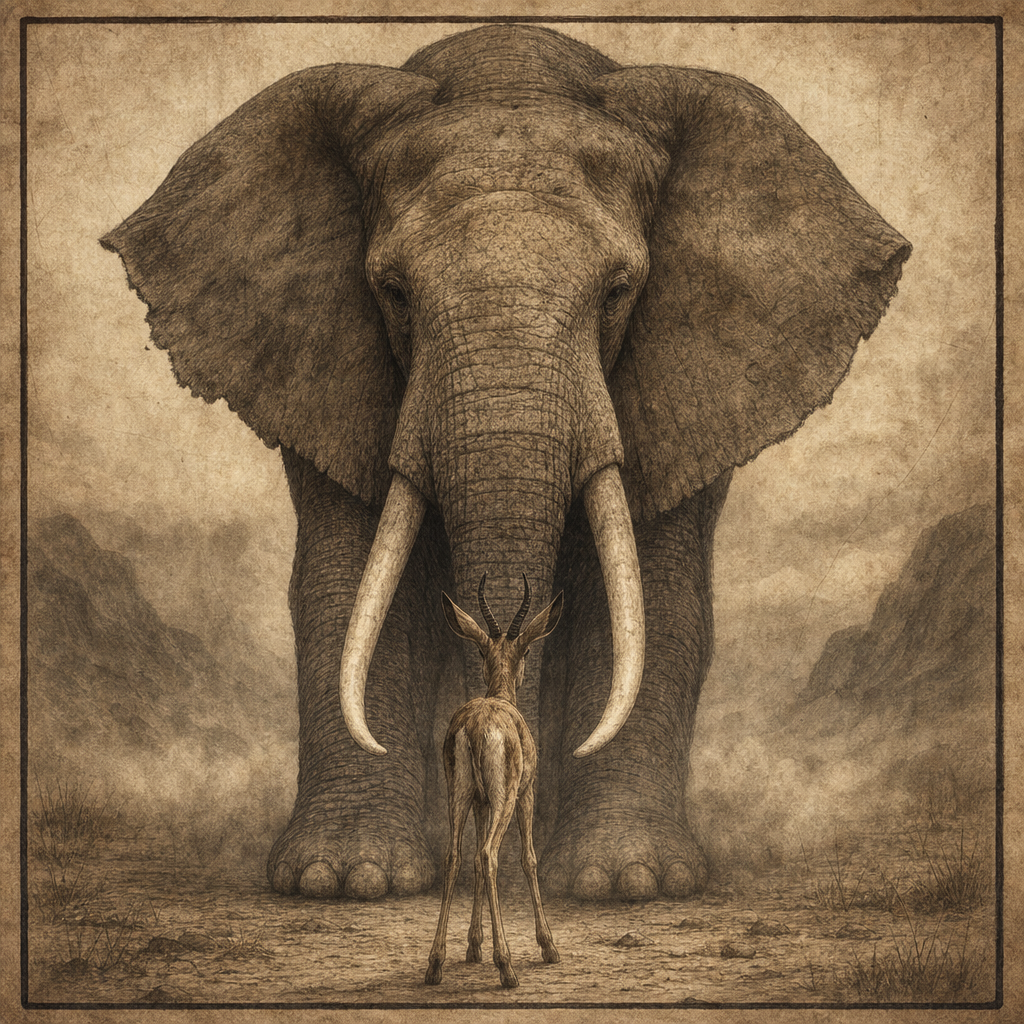
Then within a sudden clearing of swirling dust there appeared before him a solitary fawn named Bree. Bree was not frightened by Mutanda, standing calm and still amid the chaos of the approaching storm. She looked up at the charging wall of muscle with no more concern than if her were a dark cloud that loomed overhead.
Seeing this knobby-kneed yearling standing her ground before him, Mutanda was momentarily startled and pulled up short. Perplexed, he held his head high and looked down upon Bree over his ivory tusks. He swung his massive gray head from side to side in fury and tore at the ground with the soft footpads of his forefeet. He weaved from side to side with menace and a twitching tail. He shook his heavy head, causing large extended ears to flap and crack against his flanks like whips. His low growls escalated to a screaming trumpet with terrible warnings of impending death that could be heard across the entire valley.
Bree looked up at him with bright glassy eyes and giggled at Mutanda’s antics.
Mutanda was mystified. He lunged a large pillar of a leg toward the little fawn with a loud thump, which had no effect. Stepping back while shaking and tossing his head in frustration, he launched a series of short charges with his trunk raised and sniffing the air, issuing shrieks of disappointment. He ripped up nearby trees with his trunk and tossed them across his back, his head jerking and weaving with tension. He kicked up large clouds of dust and blew a loud final warning, curling in his trunk as he prepared to charge the impudent creature.
But when his trumpeting died away, his flapping ears stilled with alarm as they detected the soft sound of singing. With her eyes shut and head held high, Bree was enjoying the sun penetrating her fur and filling her with warmth while she stood and sang to Mutanda.
It’s not known what song she sang to him that day, but its effect was clear. Mutanda was now silent with a lowered head, ears pulled back and diminished, his trunk curling inward. The beast was subdued.
As the dust from Mutanda’s rage settled and Bree finished her song, she looked up and smiled into the old blood-shot eyes of Mutanda hovering above her. But her breath caught in her throat when she looked around and noticed for the first time the carnage that was strewn all bout her. She saw just a few paces away the body of her own mother lying in a twisted heap among the trampled grass.
Bree stepped over and nudged her head against the lifeless body, trying to wake her mother up. But her mother would never be waking up again. The blood from her corpse left a rust-colored streak along Bree’s white face, running from the eyes that saw to the mouth that had sung – a stain that all her kind still bears to this day.
Bree looked around the valley and realized there was not a soul to be found and that she’d been left behind. In that moment something cold seeped inside her that would change her forever. She looked back to Mutanda, who now had his head turned sideways to watch her more closely. When their eyes locked, he saw the change in her immediately.
The spell was broken.
With wide panicked eyes and a pounding heart, Bree turned and leapt so high in the air a crest of white fur burst out along her arched back. It was a sign of her fear for all the world to see. She sprang away and ran for her life with all the wind her thin legs could manage, feeling the ground shake around her as Mutanda chased after with renewed violence.
No matter how hard she ran, with those young legs of hers she could not outrun Mutanda’s quick walking gait – but nor did he ever gain on her. Bree ran and ran, looking everywhere for her herd, but she was always alone with Mutanda right on her heels. She ran in this way for so long it seemed she’d been running her whole life, never daring to look behind as the pounding of her heart matched the pounding of Mutanda’s feet, driving her ever onward.
More than once, she caught sight of her herd, spotting their familiar lyre-shaped horns on the distant horizon. But always alerted by the warning flash of white fur on her back while bringing Mutanda with her in her shadow, they would always flee, and again she’d be left behind.