



Herero and the First Junar
It used to be that giants lived among men. Men rarely ever saw the giants, and even then, only in the dark since giants would sleep during the day within their caves, only emerging after the sun went down. They invented hunting and perfected it into an art form. They kept the secrets of the hunt closely guarded, realizing the danger it would be in the wrong hands. Then it happened that over the years the giants began to disappear until only one, named Pemba, remained.
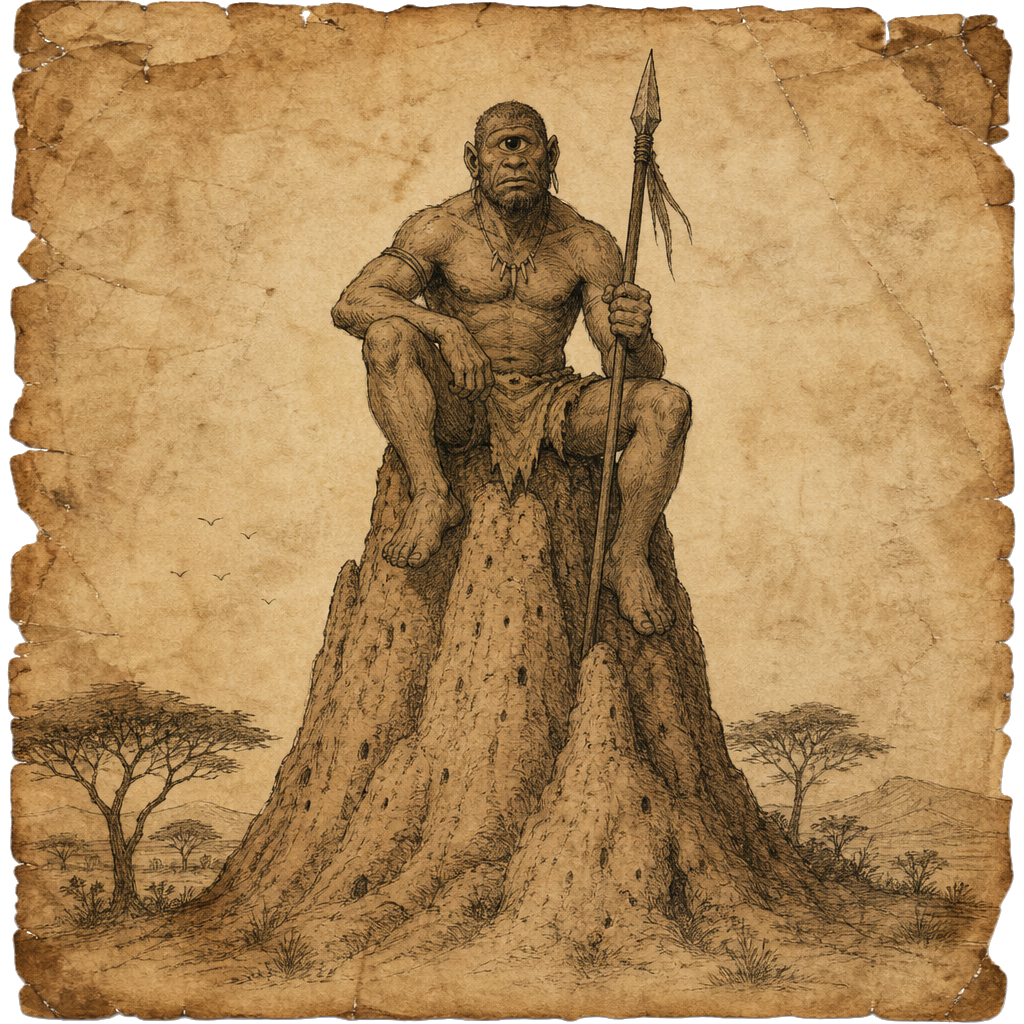
Pemba and the man Herero were friends, having crossed paths many times within the evening forest. But despite being Pemba’s friend, Herero had never seen his face; only occasionally would he perhaps catch an outline by moonlight. Overcome by curiosity, one evening while they were sharing a meal under the stars, Herero slipped some medicine into Pemba’s food which eventually put the giant to sleep. At daybreak, Herero was astounded to find his giant friend had only one eye above his nose.
When Pemba finally woke up, he was ashamed. He picked himself up and led Herero into the jungle where he seated himself on top of a termite mound. Pemba looked at his friend with his one eye and said, “Listen carefully to what I say, for after today you will have no more opportunities to learn what I have to teach.”
He then revealed all the secrets of the hunting lore: how to dispel the dark powers that are released at the death of an animal, how to keep yourself pure so that animals would not sense you and flee or attack, and much more. As he spoke, his body sank into the termite mound, and as his head vanished, he stopped talking.
Herero tried to dig up the termite mound in an effort to save his friend, but Pemba was gone. Though full of remorse, Herero went back among men and chose a select few that he trusted to share his new knowledge of hunting with, so men must no longer go hungry. Thus, it was that Herero formed the first Junar.

The Children of the Dance
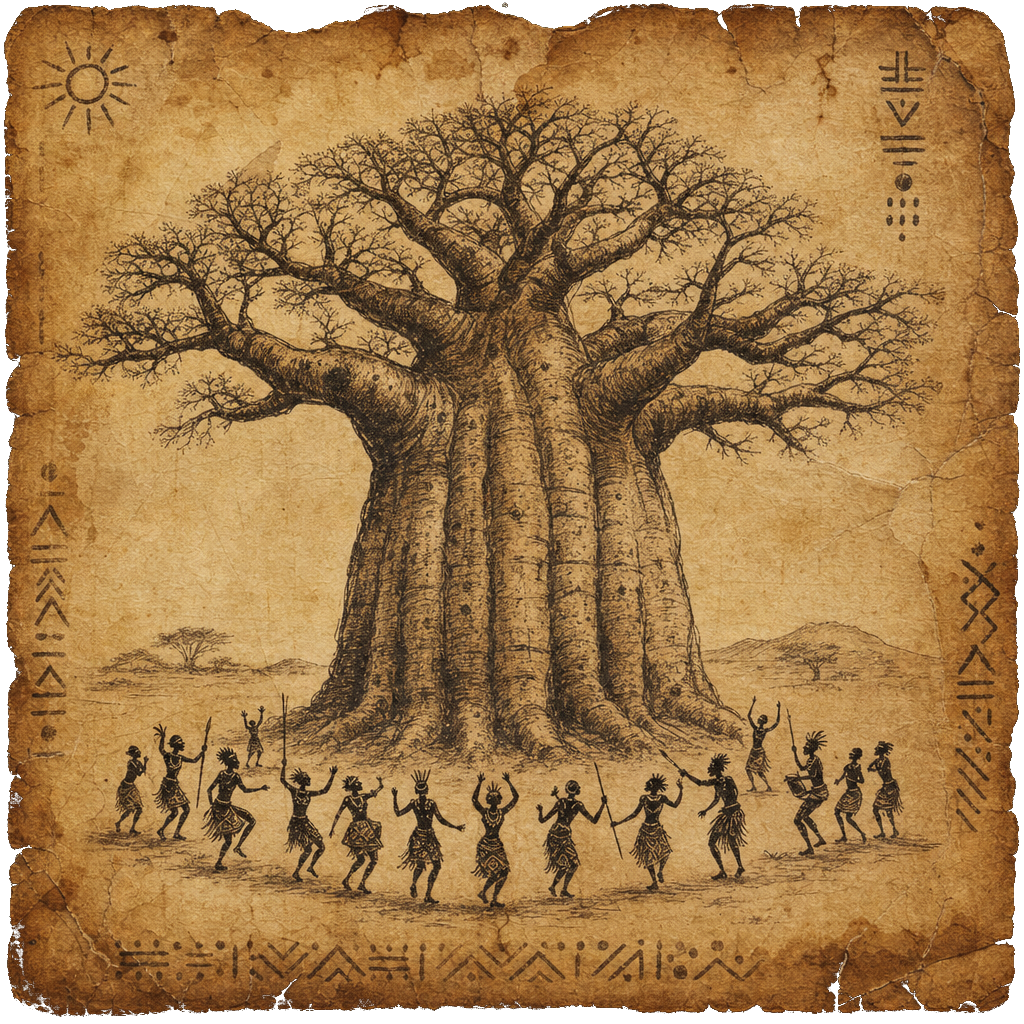
It was many years ago since the great baobab tree bore the fruit of life which populated Vaal, and the tree remained strong and healthy as it continued to instruct the men who attended it. Many men came to worship the tree and in time they were joined in their worship by many of the daughters of Herero.
The baobab tree instructed its adherents in all the refinements of life such as art, music, and particularly dance. Thus, they were often referred to as Children of the Dance. These men and women lived in the shadow of the great baobab, and it wasn’t long before they began offering sacrifices to the tree. The great baobab was pleased and in return produced the karite, a new kind of nut the Children of the Dance loved to no end.
One afternoon several women were gathering karite nuts from around the base of the baobab tree. When they had finished collecting the nuts they found their hands were covered with the oil produced by the karite and one of them wiped her hands on the trunk of the tree. The great baobab loved the savory moisture and asked for more, so all the women began rubbing the slick nut oil around the smooth trunk of the tree. It wasn’t long before the women noticed a new appendage grow from the trunk of the baobab as the tree shaped a wooden member for the purpose of coupling with the young women. The women obeyed, and in the process they each mutilated themselves and so brought about menstruation among women.
It soon came to pass that one of these women became pregnant. When her time came, she had great difficulties and it was obvious this would be an unusual birth. The woman then went into the jungle to conceal herself from the others. As her labors began and the woman cried out in pain, a chimpanzee emerged from the bush and began to serve as midwife. The chimp poured water over her belly and helped guide the child out of the womb. The woman screamed in pain as the monkey withdrew from the mother the first crocodile the world had ever seen. The chimpanzee bit off its umbilical cord and buried it. Handing the baby crocodile to its mother, the monkey turned and disappeared back into the foliage of the jungle.
The woman named her child Ombure. But when she attempted the feed Ombure, he snapped at her breast before scurrying away. And though she would never see her child again, Ombure was destined to crop up repeatedly within the myths of men as the Lord of the Crocodiles.

How Men Got Fire
When Herero was still young, he would spend most of his time alone exploring the jungle. Vaal was still young as well and her jungles were vast and full of good things for him to eat so that he believed he had all that he would ever need.
Then it happened that one day he came upon a village of chimpanzees within the jungle, for in those days they lived much as men do. The chimps were a friendly band of monkeys and made Herero feel right at home there with them in the chimp village. They introduced to him the pleasures of the banana, the mango, and raw termites. They also taught him how to read the stars to find his way home, and how not to get lost in the first place.
But what consumed Herero most of all was the wildflower chimpanzees called fire. Herero had never seen fire before and he quickly became obsessed with it. Indeed, the friendly monkeys had to keep him from setting fire to their whole village. Each evening Herero would return home to the village of men and dream about the fire, only to return each morning to the village of friendly chimps to sit by their fire in awe.
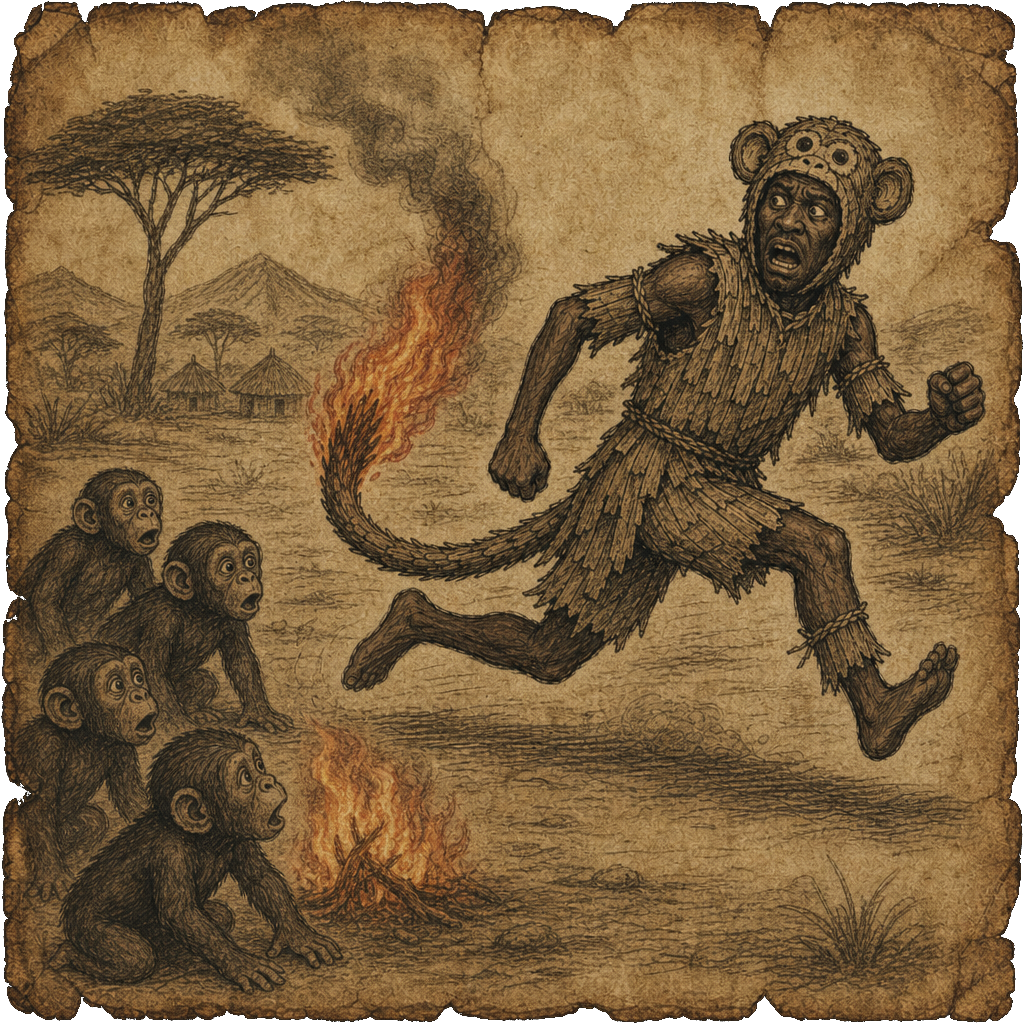
One day, Herero came up with a plan and went to the chimpanzee’s village while the adult chimps were away tending to their gardens of ripening food. He dressed himself in a costume made of pounded bark with a long tail flowing behind him. The chimpanzee children greeted this strange new creature and bade him to play with them. Herero accepted enthusiastically as he joined in their games of dancing about the fire. He leaped over the flames as the little chimps encouraged him with applause and laughter. Soon Herero’s tail caught fire, and he leaped about as if trying to put it out while howling in pain. The chimps thought this to be the greatest game of all until, to their utter surprise, the strange creature with the flaming tail ran off and disappeared into the jungle. Once back among men, Herero distributed the fire amongst them so that all may benefit from it.
The adult chimpanzees were no fools, however. When they heard what had happened that afternoon, they quickly saw through the ruse that Herero perpetrated. They were extremely put out by this – having their fire stolen from them after extending Herero their hospitality. Chimpanzees have reproached mankind ever since, abandoning their villages and retreating to the trees. They also stopped practicing all the arts they possessed in those days, choosing instead to live closer to nature and having nothing to do with the things of men.

The Antelope Bride
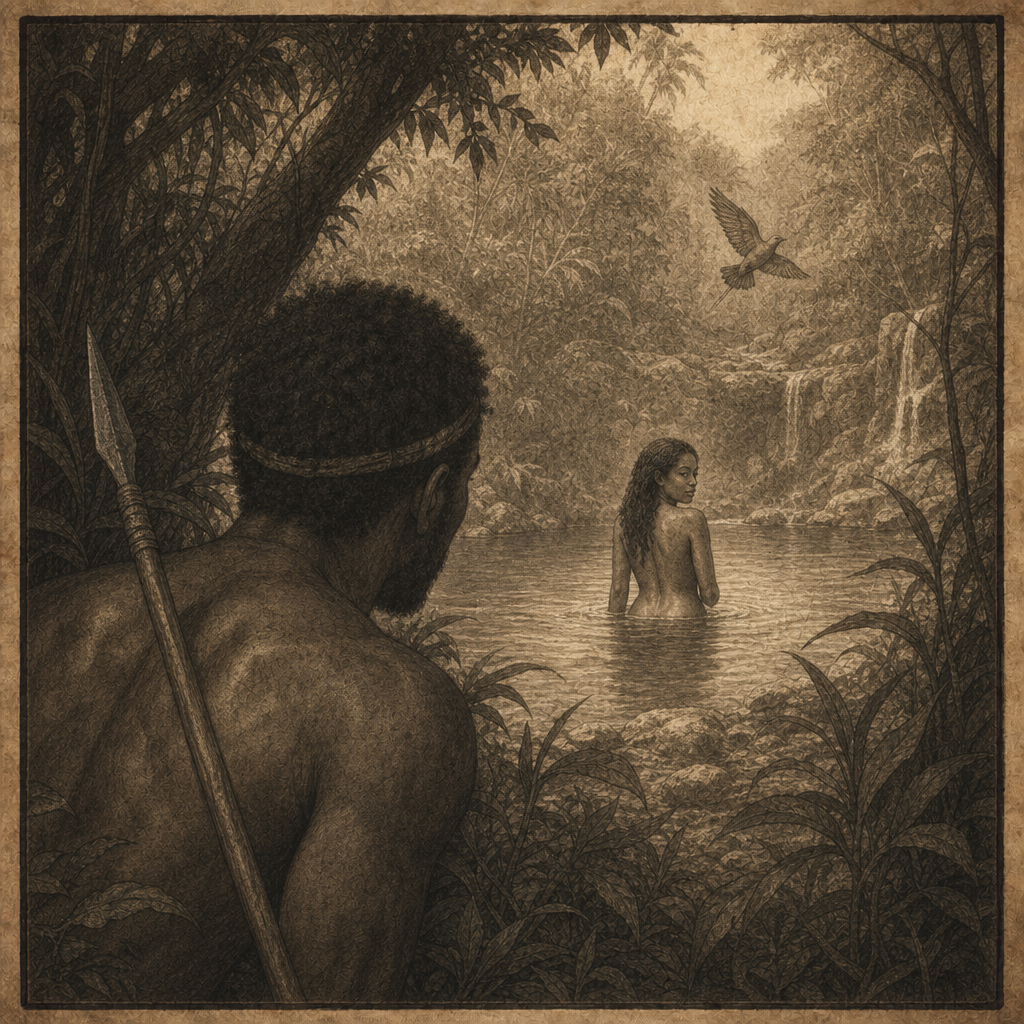
Herero had been tracking game through the jungle for several days when he came upon a beautiful woman washing herself in a secluded pool. Herero had never seen such a beautiful woman before. In fact, nobody had ever seen a woman as beautiful as this before. He forgot all about the game he’d been hunting and remained hidden in the brush, entranced by the naked beauty of the woman. He wasn’t familiar with the new feelings that she stirred within him, and he wondered where the woman had come from and how she came to be here.
When the woman finished her bath, he watched as she dressed by stepping into a golden pelt skin – a skin that transformed her into the most beautiful antelope he’d ever seen. Herero was amazed as he watched the antelope slip through the brush and bound away into the jungle. He wasn’t sure if what he saw was a vision or if it was real, but he made a point to return to that secluded pool the next day in the hopes that the antelope-woman would return to that spot to bathe again. But she was not there the next day, and over the course of many moons he returned to that pool until he was beginning to believe that what he thought he’d seen never really happened.
Then one afternoon when he again returned to the pool the woman was there. This time Herero was determined that she would not escape him, so he worked his way up close to the pool as she bathed and stole her antelope skin laying on the shore, stuffing it into his game bag. Then as he began to retreat into the brush a wood-dove thrashed from a tree behind him and flew away. The naked woman looked toward Herero and their eyes met.
He stepped forward boldly and sat along the shore, talking with the beautiful woman while she finished her bath. He told her that he was Herero, and he confessed to taking her golden pelt, telling her that he would give it back to her if she would become his wife. She said her name was Vana, which meant to grant. So, she agreed to be his wife on one condition, that he would never reveal to anyone her true nature and antelope origins. As long as he kept her secret she would be his bride.
Herero promised and they returned to his home together where they lived happily as man and wife for many rains. However, due to Vana’s unsurpassed beauty, the other men of Herero’s village grew increasingly jealous and wondered at where he ever found such a beautiful woman. But Herero would never tell them, which continued to confound the other men. Then too, when Vana bore Herero beautiful children who were growing up to be healthy and strong, the other men of the village became even more anxious to learn where Vana had come from.
For many rains this persisted as the other men begged Herero to tell them where he’d come by his bride, and he would always refuse to answer. But at last, in a moment of drunken weakness from too much palm wine, when his friends pressed him to reveal his secret Herero finally told them about the secluded pool and Vana’s antelope origins. His friends laughed at his tale and not one of them believed him. Yet when he woke from his stupor and returned home the next morning, Vana was not there and her antelope skin was no longer where she had hidden it. His bride had returned to the bush in her antelope form and was gone forever.
Herero’s loss drove him mad with grief. He searched the jungle for many moons and returned again and again to the spot where they had met, but he would never again see the beautiful woman bathing there in that secluded pool. Alas, he could not search forever. With his many children to feed he had to put his grief for Vana aside and return to his responsibilities as their father. Herero denied his loss by absorbing himself in the hunt, filling the pots of his hearth with an overabundance of game so that his children would never be hungry.
After many rains had passed, countless adventures slowly buried the memory of his antelope bride until she seemed as but a dream from another lifetime. Then one day while on junar, Herero was entering a clearing when he spotted a lone antelope with a dazzling golden pelt. Something he thought was dead began to stir within him, but he was only faintly aware that he’d only seen an antelope that beautiful before long, long ago. He watched the creature cautiously enter the clearing. As he raised his bow to shoot, a wood-dove thrashed from a tree behind him and flew away. The antelope looked towards Herero and their eyes met.

The Spear and the Beads
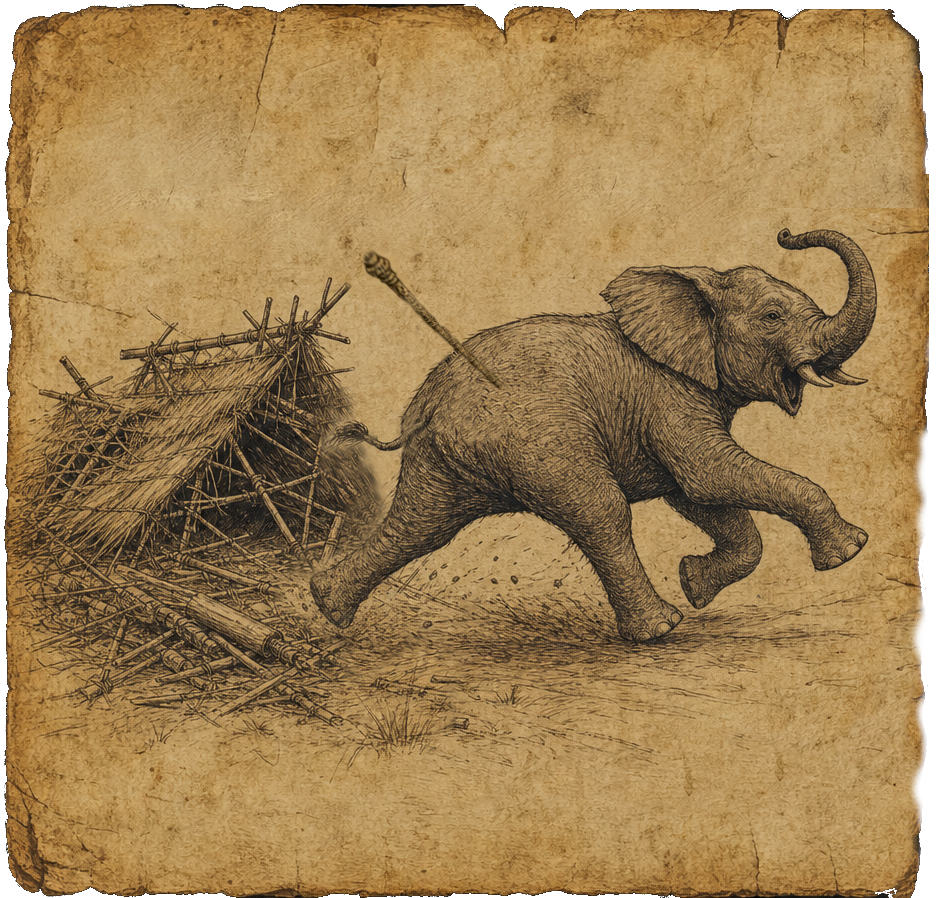
Moshi and Bochi were the eldest sons of Herero, and they lived beside each other quite peacefully for man rains, along with their wives and children. That is until the day Mutanda came to call. When the elephant came it broached their village gateway and smashed through Bochi’s hut, trampling it to the ground. Luckily, nobody was in the hut when Mutanda destroyed it, but Bochi was nearby and heard the ruckus the elephant made as it charged on through the village. When Bochi saw the carnage that used to be his hut he retrieved Moshi’s spear from his brother’s hut and took off after the elephant.
Now it needs to be said at this point that the spear in question was his brother’s favorite. It was not meant for hunting. The spear being ornately designed, it was used by Moshi only during rituals and was kept as a symbol of his status among other hunters. It wa Moshi’s most prized possession. So, it could be safely said that when Bochi reached for his brother’s spear he was not really thinking about what he was doing.
Nonetheless, having it now in had Bochi confronted Mutanda and hurled Moshi’s spear into the giant beast. Trumpeting in agony from the wound, the elephant turned and ran straight through Moshi’s hut, trampling it into the ground beside his brother’s as Mutanda fled from the village. Bochi was feeling quite pleased with himself as he watched the elephant running away, until he recognized Moshi’s spear running away with it, still embedded in Mutanda’s flank.
When Moshi heard what had happened to their huts and the part his spear had to play within the drama, he was furious. And though Bochi offered to replace the spear his brother refused to be placated. He insisted that Bochi hunt down the elephant and retrieve his spear at once. Doubtful about that course of action, Bochi offered his brother anything he desired in order to make amends. But Moshi would not be budged, and once more insisted Bochi retrieve his spear.
Failing to reason with his brother, Bochi finally set out in search of the wounded elephant. Being a son of Herero, he had no difficulty reading the tracks left by the elephant, but he knew it could be a long way off by now and it would be a long journey ahead. He followed the spoor of Mutanda for many days until it led him to the edge of a particularly dense jungle, which turned out to be the secret home of the elephants.
Near where the elephant tracks faded into the jungle was a small hut. Inside, Bochi found an old woman who was ugly and deformed, sitting over a cold hearth and an empty pot. She was blind with no eyes in her sockets, but she heard Bochi approach.
“Hello mother,” said Bochi.
“What is it you want?” wheezed the old crone.
Bochi told her then about the trampled huts, about Mutanda and the spear his brother demanded be returned. The old hag listened to the story and then after some consideration she told Bochi precisely where in the jungle he would find what he was looking for. Heartened by this unexpected revelation, he thanked the old woman and set off at once.
It was dark as night within the jungle, and wasn’t long before Bochi was stopped by a deep voice rumbling from the nearby shadows, “What is it you want?”
Bochi explained to the voice that he had lost his brother’s spear and was there to retrieve it. A wall of shadow slowly lumbered toward him then, shaking the earth with each step. Bochi suddenly saw within a shaft of light an elephant’s eye towering overhead, looking down upon him. “How exactly would this spear have ended up here?” came the booming voice.
Bochi explained very reasonably to the beast that he accidentally hurled the spear at an elephant and then it inexplicably ran off with the spear still buried in its flesh. He then added that the old woman living along the jungle’s edge told him he might find what he was looking for here.
Mutanda’s eye looking down upon Bochi never blinked as he considered this, then told the man to follow him as the elephant turned and pushed deeper into the jungle. Soon they came to a shadowy clearing where Bochi could barely make out in the dim light a very large pile of spears. “If we have your brother’s spear it will be here,” said Mutanda.
Bochi began searching through the spears, noting the blood stains on each of their sharpened ends. When he glanced up and around, he was shaken to see the entire perimeter of the clearing lined with the glinting eyes of elephants watching him from the shadows. He was relieved when he finally found what he was looking for.
“This is my brother’s spear,” he said to Mutanda then was led by the elephant back to the edge of the jungle.
The old crone was sitting in the doorway of her hut when Bochi and Mutanda emerged. Upon sight of the woman, Mutanda bowed his huge head. “Mother of Elephants, the man has found what he came for,” he rumbled.
“Very well,” she hissed, dismissing Mutanda with a flick of her hand. And though she had no eyes she turned her empty sockets toward Bochi and said, “I now have a gift for you as well.” She then handed him a small pouch and when he opened it, he found the most beautifully crafted beads he had ever seen in his life. Each bead was ornately carved and meticulously polished, all differing colors, rich and enchanting.
He thanked the old woman profusely and she merely cackled, which did not sit well with Bochi, so he set out on his way toward home without another word.
Bochi felt tremendous relief when he was finally able to return the spear to his brother. He was also very happy to see how pleased his wife was with the beads he presented to her. She would now be the most beautifully ornamented woman in the land.
She immediately took the beads to Moshi’s wife to show her the new treasure Bochi brought home for her. She spread the beads out before them so that they could get a fine look at them, and when Moshi’s newborn baby saw the shiny beads, it too became entranced by them. The baby crawled right over and before either woman knew what was happening it put several beads in its mouth and swallowed them.
The women were horrified, but when Bochi heard of what happened he was furious. He immediately confronted his brother and demanded the return of the beads. Moshi tried to explain that it was only a baby and did not mean any harm. But Bochi would hear none of that, he wanted his beads immediately. Moshi offered to reimburse his brother in any form he wished, but Bochi held fast in his demand for the bead.
“Well,” Moshi said, “What goes in must come out eventually. Give it some time brother.”
Four days then passed but no beads emerged. In the end Moshi was forced to kill his child, cutting the baby open in order to search its entrails. Upon finding the beads Moshi returned them to his brother. And though Moshi was glad to have his spear back, and Bochi was glad to have his beads back, the relationship between the two brothers was always a bit strained from that day forward.

Herero and the Lioness
A lioness picked up a piercing thorn in her paw while on the hunt and she could not remove it herself. She licked her paw and tried to work it out, but she could not. She was in terrible agony as she began to limp toward home, mewling in pain with each step. A thorn could be a mortal wound for a lion in the bush. Not only was she now vulnerable to attack but she could no longer hunt and feed her cubs.
Herero was taking a nap in the shade of a fig tree when the mother lion found him. The lioness nudged Herero with her sore paw to awaken him. He immediately noticed the wounded paw and gently examined it. Spotting the thorn, he removed it easily, and with a stream of blood from the open gash there was instant relief for the poor lioness. Herero washed the wound with his water and escorted her to a nearby bush where he could hear the cries of her hungry cubs.
However, the mother’s paw was still sore, so Herero left her with her cubs as he set out and killed some game, bringing it aback for all of them to share.
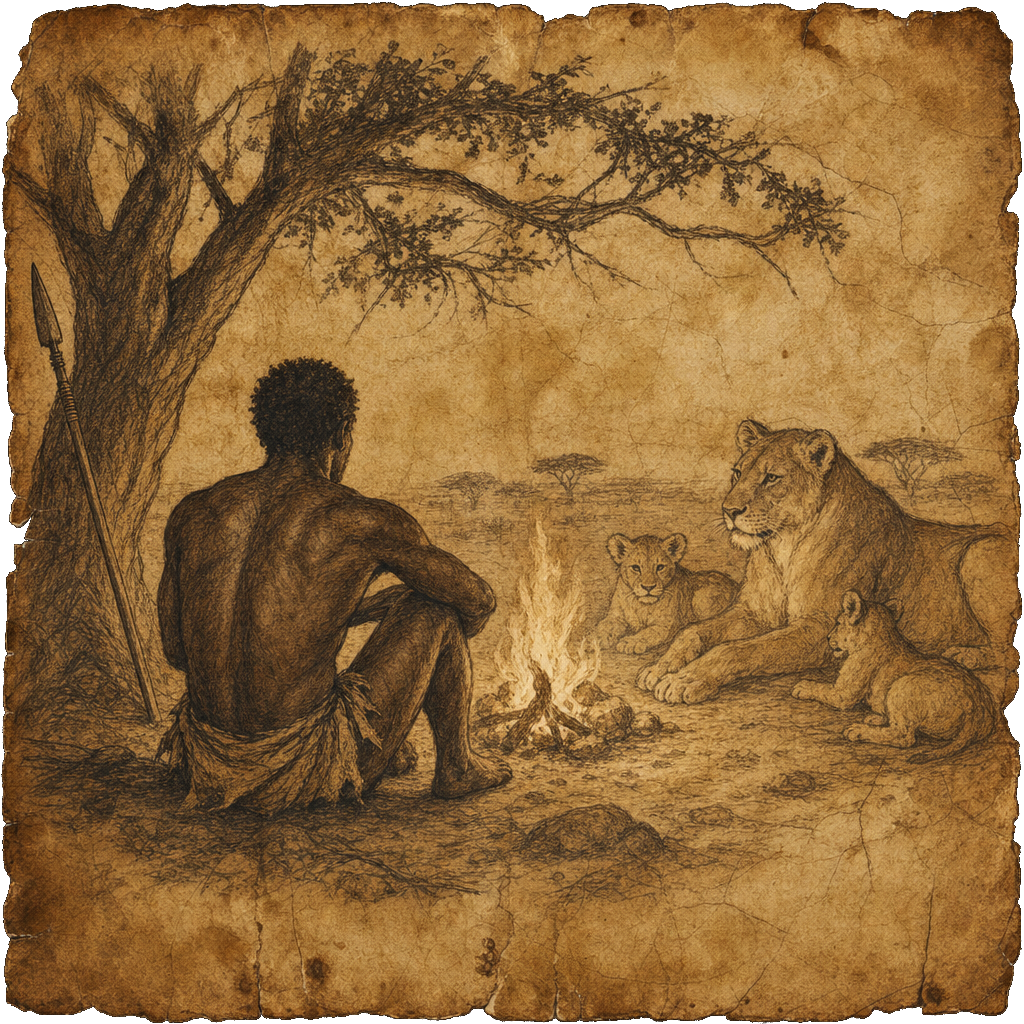
From then on, the lioness and her two cubs travelled with Herero acting as his hunting dogs, and they all shared in the game they killed. Herero was very happy and his life uncomplicated.
But after a while his children, now grown, had noticed their father’s absence. His eldest sons, Moshi and Bochi, set out in search of their father and after several weeks they finally came upon Herero’s camp. It was an idyllic evening with the stars just emerging overhead as the two brothers approached.
They were horrified to discover their father surrounded by three lions near a small campfire. Even more odd was that their father appeared at ease as he sat playing a tune on what seemed to be a stringed instrument of his own making, singing to the lions. Moshi and Bochi paused for a moment, struck by the beauty of the scene, but quickly regained themselves at the idea of their father being held captive and made to sing for the amusement of beasts.
The brothers let loose their arrows into the small pride killing the two smaller ones straight off. Herero looked up from his playing in horror as his two sons charged from the darkness and into the clearing brandishing their spears. The mother lioness roared in fury as she pounced on Bochi. Herero screamed for them to stop as Moshi’s spear pierced the flank of the lioness, and with a guttural yelp that seized Herero’s heart, she fell to the dust.
Bochi rose to his feet to finish the kill as Herero rushed over and pushed his sons aside. The two brothers were aghast to see their father kneel next to the dying lion, cradling its panting head in his arms. “She was my friend,” Herero said in anguish. Herero felt the head of the lioness grow heavier and heavier in his arms as her blood pooled around them and her spirit drained away into the night.
The brothers, now realizing their error, tried to console their grieving father. “It is not natural for man and beast to commune as equals,” Moshi offered. Bochi agreed, adding, “Yes, it was doomed from the start to end badly.”
With all the strength of his sorrow, Herero lifted the lioness in his arms. And as he carried the body of his friend off into the darkness he replied to his sons, “What you find unnatural was my attempt to define happiness for myself, and in the society of men all such attempts are doomed for a bad end.”

For an interactive lore companion that unlocks the glyphs associated with the myths of the Batu, click the link below and experience
The Kanar Exegesis