


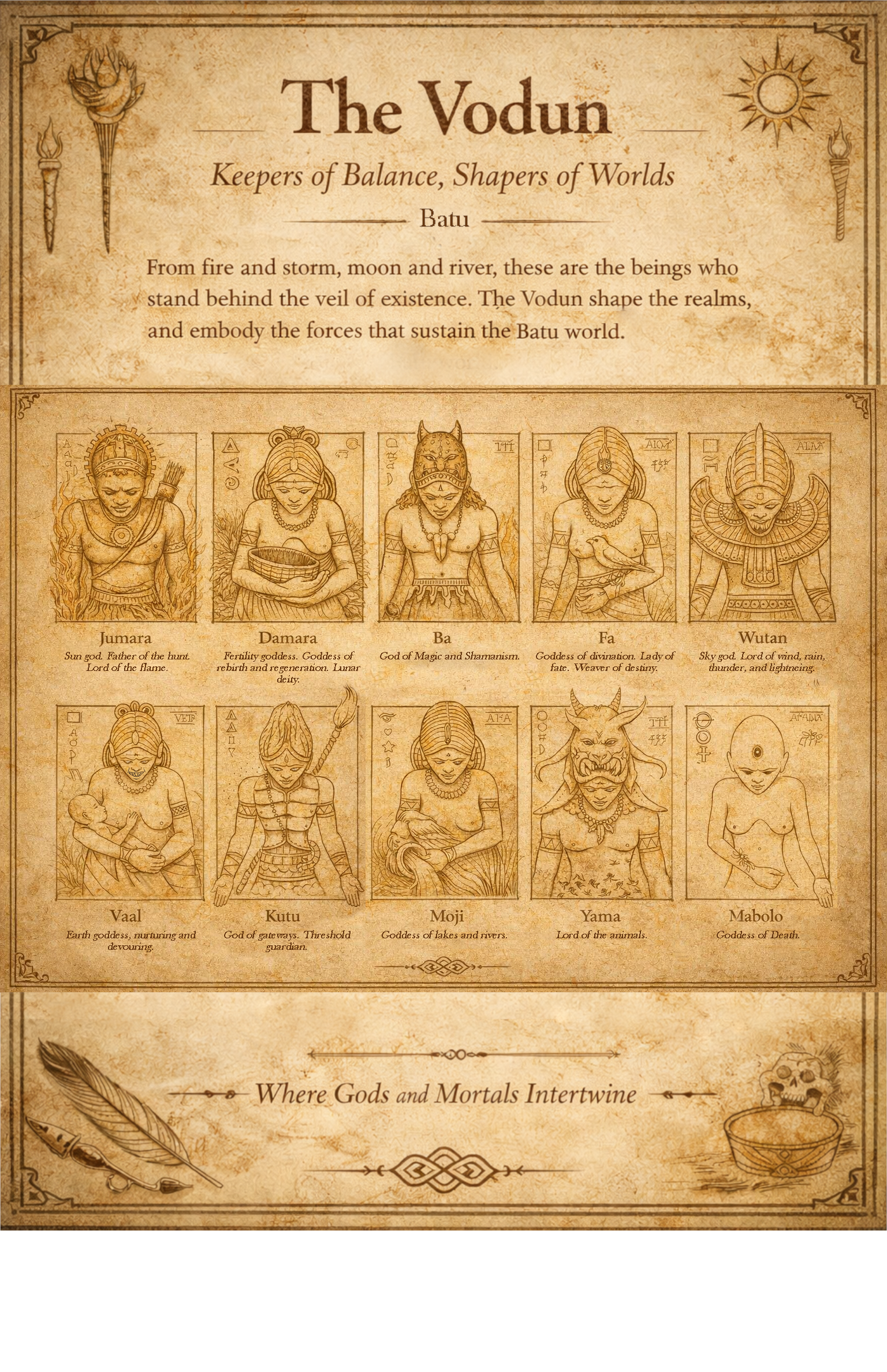

Jumara
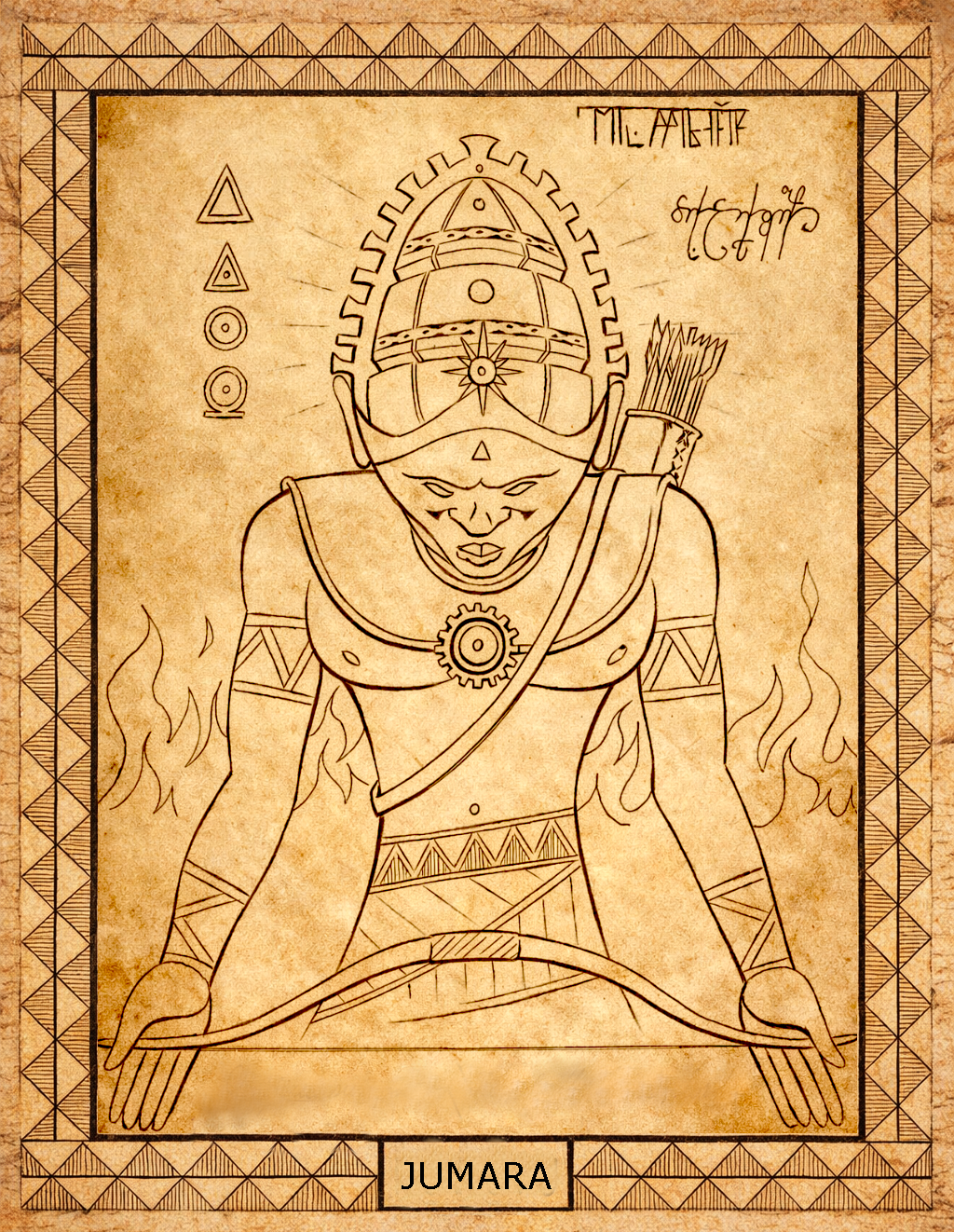
Jumara is the solar deity, though his celestial manifestation as the sun is referred to as Apara. It is only when depicted in human form that he is called Jumara. The name Jumara literally translates as above the world. His human manifestation casts no shadow, and he is often depicted carrying a jeweled spear and wearing a helm adorned with rams’ horns. Jumara was first formed from the yolk of the Cosmic Egg while his sister-wife, Damara, was formed from its egg white.
Also referred to as The Father of the Hunt, Jumara is the original and greatest of all hunters. All arrows are linked to Jumara, the feathers fletching their shaft seen as ascension symbols. The sun’s rays are his arrows, and the herds he shoots at are the stars. His quarry is Jukun, the lunar manifestation of his sister-wife, Damara. The return of the stars each night is his promise that nothing is lost forever. Thus, the herds of Mara – the world of man – will replenish as well.
Jumara sails across the sky each day in his golden pirogue in pursuit of Jukun. Jumara becomes the lion manifestation of the sun, named Amadou, when his flames get extinguished by passing through the Falls of Alodia – the gateway to the underworld. He is reignited when he leaps into the river of fire during his exit from Alodia every day at dawn.
The heron is Jumara’s herald, a symbol of the morning sun, which is revered as a herald of light. The Batu creation myth has the world coming into being with the cry of a heron. The heron surmounts storm clouds and are thus used as a symbol of spiritual ascension that rises above the storms of life.
Almonds are Jumara’s symbol of fertility, purity, and hidden truth. Juice pressed from it is equated with semen. It is believed that a virgin can wake pregnant if she sleeps under an almond tree and dreams of her love.
Amber is linked to solar energy due to its color. The Batu word for amber literally means Lion Soul. The resin is thought to be formed from the remains of lions and embodies the cat’s courage. Amadou is the lion manifestation of Jumara, and the tears of the great cat when shed are tears of amber. Amber is often used as a talisman and cure-all. Bees are also born from the tears of Jumara; honey being connected to the sun due to its golden hue and the idea that bees gathered honey by sipping dew from flowers – the milk of paradise.
The mimosa flower is linked to the Jumara due to the color of its golden flowers, and the way its leaves respond to the sun by unfolding to light stimuli. The mimosa symbolizes the certainty of resurrection, its solar color and unfolding to the light everlasting.
The palm tree and its leaves are solar symbols, associated with victory, supremacy, longevity, and immortality.
Red is the symbolic color of Jumara and the sun – red being an active, masculine color of life, war, energy, aggression, and strength. The pyramid-triangle is Jumara’s symbol for fire, life, male, divity, solar royalty.
Jumara breathes life and is known as The Creating Eye. Man’s first yara was a love ballad sung by Jumara to Damara. When a person dies, half of who that person was is returned to Jumara as their song is being sung during the burning of their funeral pyre. The other half, the skull and primary organs, are returned to Damara during the burial of the person’s boma - their funerary vessel.
Though he is the embodiment of power, wisdom, and justice, Jumara’s pride and self-confidence can often reduce him to a monarch dazzled by his own power. Blinded by his own light, he often becomes a tyrant, though he invariably views himself as a guardian. He can be as intolerable as he is admirable, and waves between these two extremes.
Jumara is the male godhead of the Imaad spiritual tradition, which concerns itself with the knowledge of ethics, linguistics, and codes of behavior. Damara is the female godhead of the Imaad.

Damara
Damara is the fertility goddess and sister-wife of Jumara. The name Damara literally translates as within the world. She was formed from the white of the Cosmic Egg, and hers is the female creative principle. Damara’s breath produces forms and regulates their modes of existence. Her breath is also the divine gift of consciousness, returned at death. She breathed into humans to make the world of Mara conscious of itself. She is both lunar and mother goddess who created the universe with her brother-husband Jumara.
The acorn is her symbol of fecundity, prosperity, spiritual growth from a kernal of truth. The agate is her gemstone, itself associated with Jukun, Damara’s celestial form. The agate symbolizes fortitude, happiness and sexual success, and is often used as a charm to deflect weapons. Baskets and date palms are also symbols of her fertility.
Mount Kunama is associated with Damara, where rain clouds gather and the sources of rivers are found, linking it to fertility.
The vine is a symbol of fertility and regeneration, the fruits of Mara. It was the first plant found following the flood of Mugasha and is in the Batu prophecy to be the first sign upon finding their final home.
In the preflood civilization Damara’s temple was burnt down the night Mugasha – the founding father of the tribe – was born. After the flood he rebuilt it at the foot of Mount Kunama for the original bands of the Batu.
The ibis is Damara’s daylight herald. It’s beak curves like a crescent moon.
Tapu is the trickster hare who is the creative and destructive agent for Damara.
The inverted pyramid triangle is her symbol.
Cowrie shells are associated with her due to their labial-shape, which symbolizes a source of life. Necklaces made from cowrie shells are used against sterility, are linked to fecundity, sexual pleasure, and good luck.
Ba
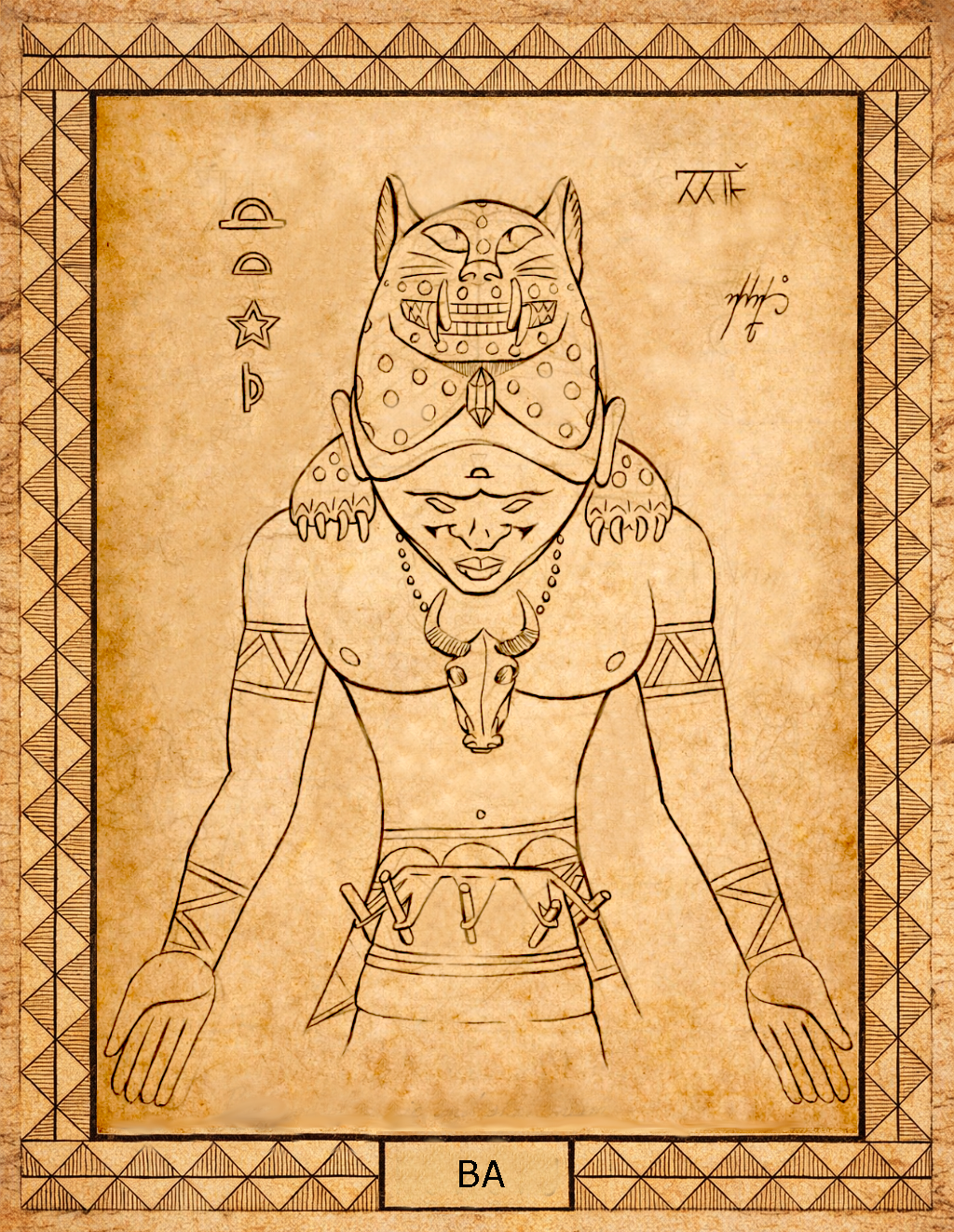
Ba is the son of Jumara and Damara, twin brother of Fa. He is the god of magic and shamanism, which represent the powers of the gods allowed for a select few humans. Ba is the male godhead of the Imaan spiritual tradition, which concerns itself with knowledge of the spirit worlds. Fa is the female godhead of the Imaan tradition.
It is Ba who sends the call to shamanism into a man’s dreams, visions, or direct visitation. Refusing his call may result in illness, insanity, or death. It is also Ba who chooses and assigns a male initiate’s totem by way of the jawara ben-bella rite of passage into manhood. He beats a drum, which matches those used in vision quest rituals.
Ba has a staff similar to the ones every shaman posseses, which symbolizes the Obamti World Tree as a bridge between realms. The shaman’s staff is called a Phurba. Its carvings are divided into four parts vertically: 1) the underworld of Alodia 2) the living world of Mara 3) the sky of Mawu 4) and the celestial realm of That Which Has No Name. Each realm is represented horizontally around the staff with the four major figures associated with each realm. The base of the staff has Gao – the giant python guardian – coiled around it. The crown depicts a carving of Shukar, the eagle herald of Ba.
Ba is the god of transformation, transforming shamans into other animals and, through them, transforms the entire culture. Ba is the gateway to all animal powers, and as such is seen as having a profound affinity with all the beasts of the world.
The quartz crystal is associated with Ba as a power object. Known as the living rock, it is an aid to the shaman because it channels his powers. The quartz appears the same regardless of his state of consciousness. The material and spiritual nature of quartz is identical. It is solidified light, involved with enlightenment and seeing. When put in water that is then drunk, initiates will see ghosts. The pebbles in the shaman’s rattle are quartz crystals.
Fa
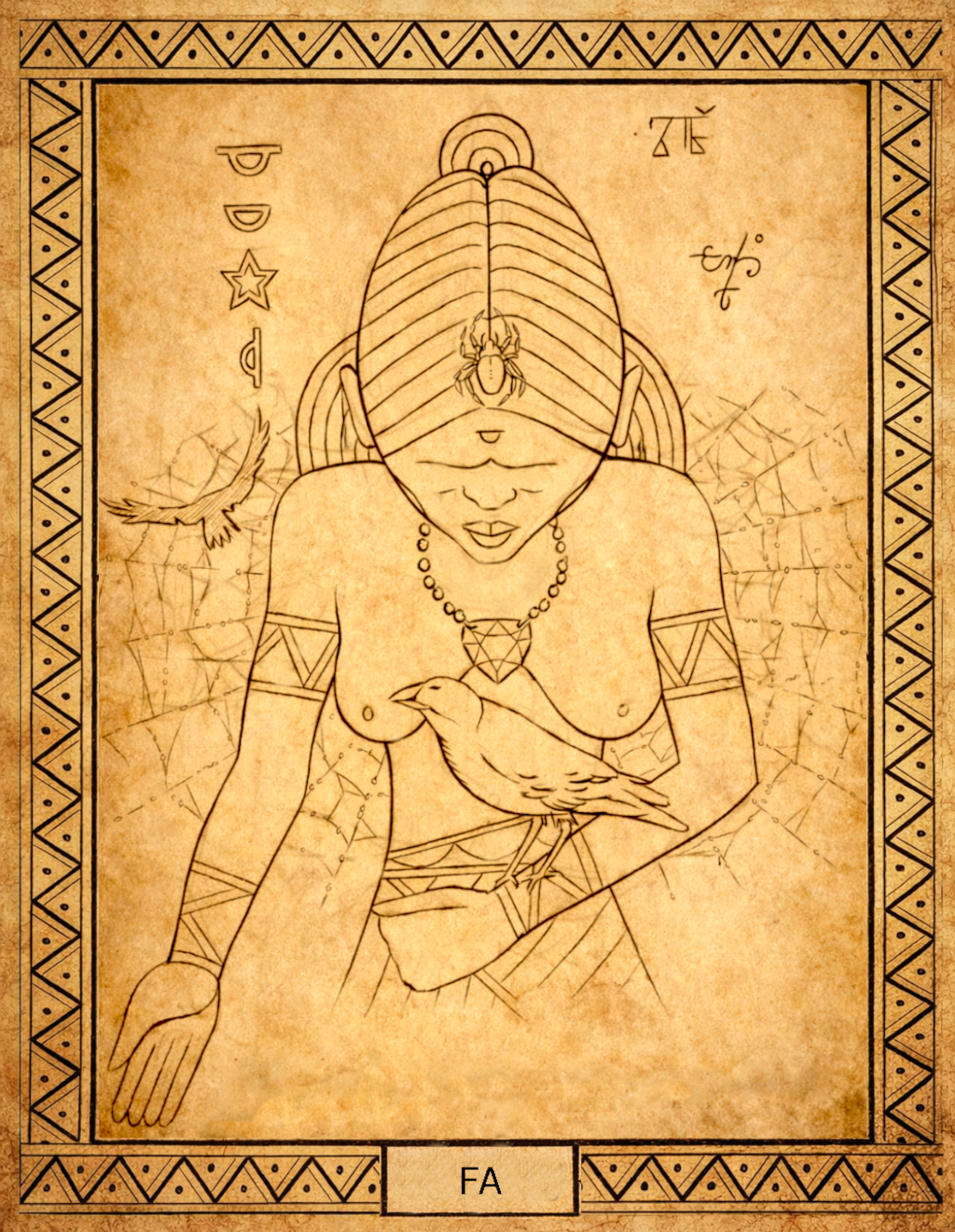
Fa is the daughter of Jumara and Damara, twin sister of Ba. She is the goddess of divination in human form, depicted as an old woman with no eyes. Her blindness symbolizes her inner vision. She uses a hori crystal, a gem with 16 facets that she can hold up to her empty sockets to see the past, future, and present. Diviners using their various tools dictate the facets Fa will look through.
Fa is also the goddess who measures time, playing her melodies on a stringed zither. She is the goddess of mirrors as well, the reflective surface of water providing another way for her to view the past, future and present. The human heart is itself a mirror that reflects That Which Has No Name, which only Fa is able to see into.
Fa resides in a cave with her two ravens, Faro and Jaro. The cave is a temple, a place that stores the germinating powers of the earth. As an oracle she speaks with double eanings, misleading and deceptive. It is through inhaling fumes from her cave that enables human oracles to prophesize.
Hyenas are linked to Fa as her acolytes and divination due to their night vision.
She is well known for dancing while reciting her songs. The way to reveal mysteries is to dance them out. You must know the dance to know the mystery. Dancing invokes and reinforces curative energies. Uninhibited dancing is therapeutic, providing a release from the tension of social rules. In trance dancing the transformation symbolizes the attainment of a supernatural state where the dancer is in direct touch with Fa and the power of ones kra – a link made clear in Fa iconography depicting her dancing.
She controls the destiny of men by watering the trunk of the Obamti baobab tree.
She is linked to medicine in that divination is a diagnostic tool for disease and death.
Fa is the female godhead of the Imaan tradition, which concerns itself with knowledge of the spirit worlds. Her brother Ba is the male godhead of the Imaan tradition.

Wutan
Wutan is the son of Fa and Ba, and twin brother of Kutu. Though he is primarily the sky god, he also helps his father Ba in shamanic work as an ally to human shamans. Wutan was created when sky and earth first separated. He is that which flies without ever landing. It is Wutan who uses his herald, Pama, a swift, as well as the wind itself, to deliver and receive yaras for Jumara. He is in this way a manifestation Jumara’s breath of life.
Wutan sends demons on the wind to deliver evil and illness, rumors, and the scent of one’s prey. Wind is equivalent with spirit, one’s yara, and the generator of life. Wutan is also the lord of musical instruments like the kulu flute. The Bull roarer is Wutan’s musical instrument of choice.
Storms are Wutan’s way of teaching humility to men. Creative activity is unleashed by way of storms, the beginnings and endings of epochs, regimes, and the world itself. Thunder is the voice of Wutan that presages the corporeal manifestation in Mara, and often presaging some revelation.
Some say Wutan’s body is pocked with holes, and when he devours the sun each night it is through these that the sun shines through as stars, until giving birth to the sun again each morning. Wutan is also the Lord of Winds, thunder, and lightning. When he strikes the earth with lightning that place becomes sacred ground. The concretion of sand where lighting has struck is also used in love charms. People hit by lightning will bear the mark of Wutan if they survive, or if they die, they are among the honored. Some seers and oracles receive their gifts through being struck by lightning. Diamonds are symbols for lightning. Lightning is the writing in the sky with Wutan’s words. A barbed-shafted arrow is a symbol for Wutan, representing his thunderbolt.
Wutan draws water from Umi, the celestial river, a band of stars bridging the night sky, and that is where rain comes from. Thunder comes from Wutan’s drum, which he uses to summon the rain from Umi.

Vaal
Vaal is the personification of the physical world. She is the mother goddess, the world of Mara being her body and the underworld of Alodia her womb. She is the cannibal ogress, mothering life only to consume it. She both gives and destroys, both nurturing and devouring life. Thus, she is depicted as a motherly figure with sharp teeth and claws. She also has a long tongue to lick the blood of her children.
Like the Obamti tree, she is known as The Great Mother. As the mother earth, Vaal allows mankind to live off her fruits, but she demands the four organs of the dead for her own nourishment, and is in this sense a destroyer.
Her tooth necklace is associated with power, aggressiveness, and generative vitality. It is a castration symbol, representing the taking of power from predators and rendering them impotent.
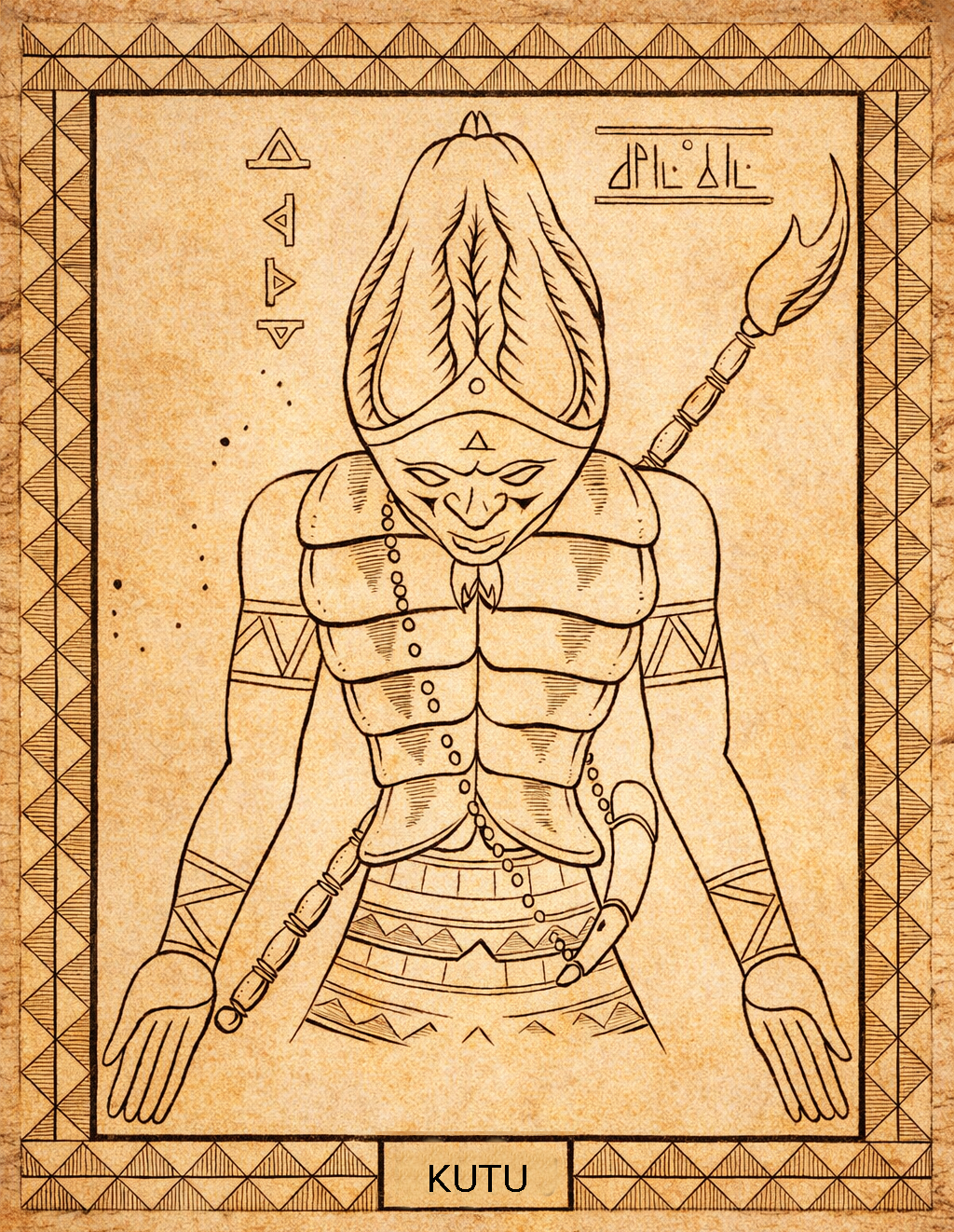
Kutu
Kutu is the guardian god of gateways, passes, entrances, passages, treasure, and secret or sacred places. He is the Juman personification the scorpion guardians, Sotho and Thabo. He is himself a symbol of death and retribution, as well as his primary emblem as a guardian an protector of the dead. Kutu carries a conch, a great horn called kakati, that can be heard across Mara when a trespasser approaches one of his protected gateways. It is said that if you feel the touch of Kutu in your travels, sensing his hand upon your shoulder for example, you are fated to die.
Kutu is a god of tests, for it is to him that one must prove one’s capabilities and worthiness to pass through one of his gates. He is thus a major factor in rites of passage such as the jawara ben-bella rite of ascension for boys into manhood. As the warden of forbidden thresholds, he asks riddles of those who approach and will destroy those who answer falsely. He stands on the brink of man’s fate, a fate both necessary and mysterious.
Kutu is also the guardian of twins, as the combination of twins amounts to eight limbs, like his scorpion manifestation. Also like the black scorpion, Kutu flees the light and lives concealed in darkness – the gateway to Alodia, the night sky as the scorpion constellation, etc. “I am neither elemental spirit nor demon. I am merely a creature that brings death to whoever touches me.”
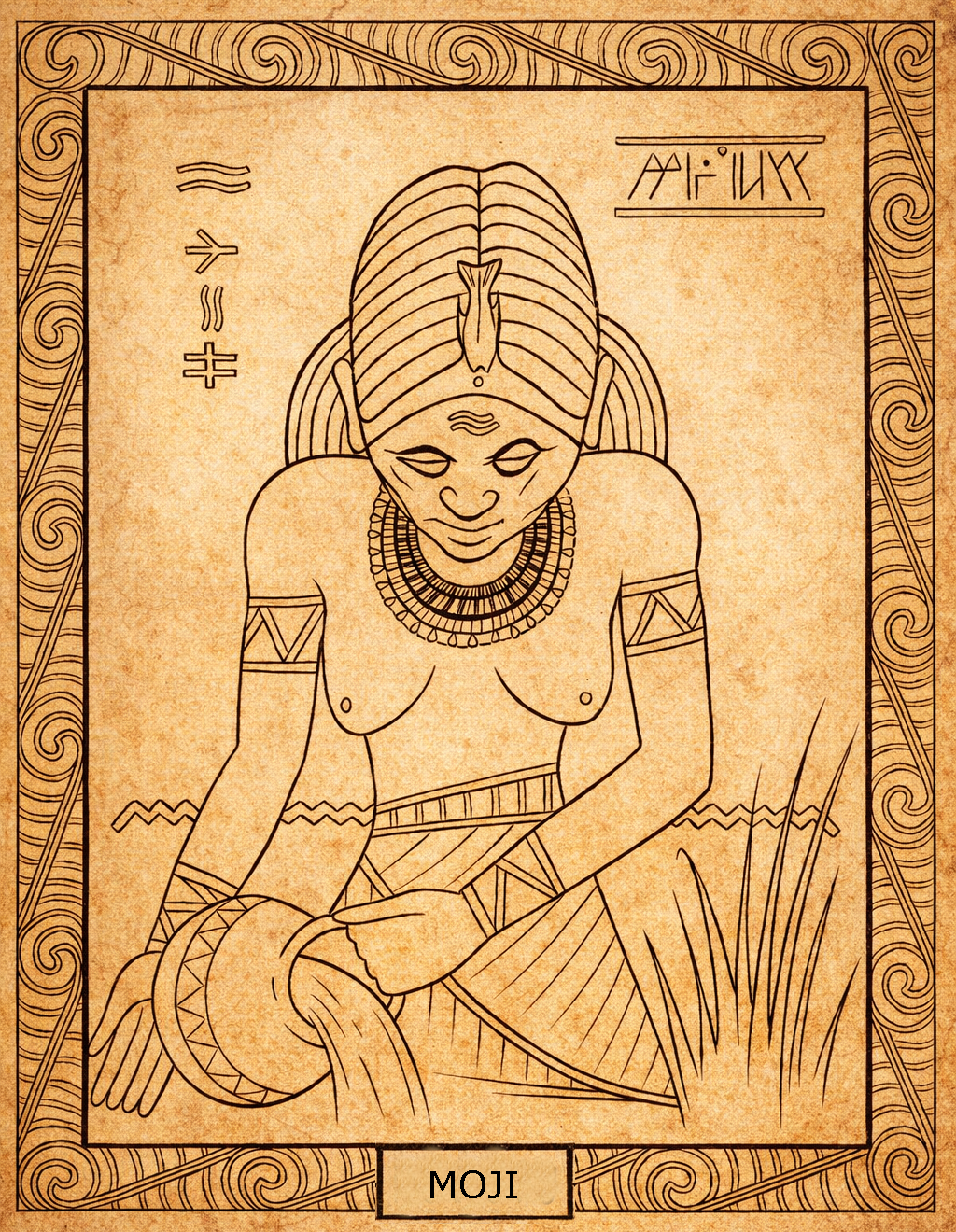
Moji
Moji is the water goddess, the amniotic fluid that flows from the birth of all life. Wutan’s wind moving over Moji’s waters combine both matter and spirit. She is the original river oracle, inhabiting the waters accessed by human mediums to make her will known.
As the goddess of water, Moji is a symbol of unconscious energy, the formless powers of the soul, of hidden and unrecognized motivations. In dreams, the dreamer sitting on the riverbank fishing, the water is a symbol of what is unconscious of itself, holds the contents of the soul which the fisherman tries to bring to the surface as his food. The fish is a creature of the psyche. A more esoteric association of water links Moji with wisdom, where the waters that dwell within the hearts of the wise is like a well or spring. The Waters of Wisdom are the waters that wash the soul.
It is Moji who dips her gourd into the celestial river of Umi, the star-studded constellation that bridges the sky of Wutan with That Which Has No Name. And it is she who pours the waters that create the rivers and lakes of Mara and Alodia. She stands atop the mountains to do this, which allows her to reach Umi, and is why rivers flow from the mountains.
It is Moji who is called upon in rituals involving purification rites. She is a patron of regeneration and cleansing. Moji is also associated with freedom, since water is free and unattached, flowing with the slope of the ground. Water makes manifest the transcendent, rendering it holy.
If Moji marks a man to die by water and removed from the world, the body is buried, while all others are cremated by way of funeral pyres. This reflects the division and opposing forces of fire and water. The spark of life belongs to the fires of Jumara unless claimed by Moji. Water is a source of both life and death; thus Moji can be seen as a goddess of creation and destruction.
It was Moji that Mugash sang to for the cleansing of Mara when she sent the flood. Mugasha sang to her, arguing that if forms were not regenerated by being dissolved in water they would crumble and exhaust their powers of creativity before finally dying away forever. Mankind would eventually be completely deformed by wickedness and sin, emptied of its seeds of life. Instead of permitting this slow regression into sub-human forms, the flood effected an instantaneous dissolution in water, where sins were purified and from which a new regenerative humanity was able to be born anew. This flood set the boundary between prehistory, and history.
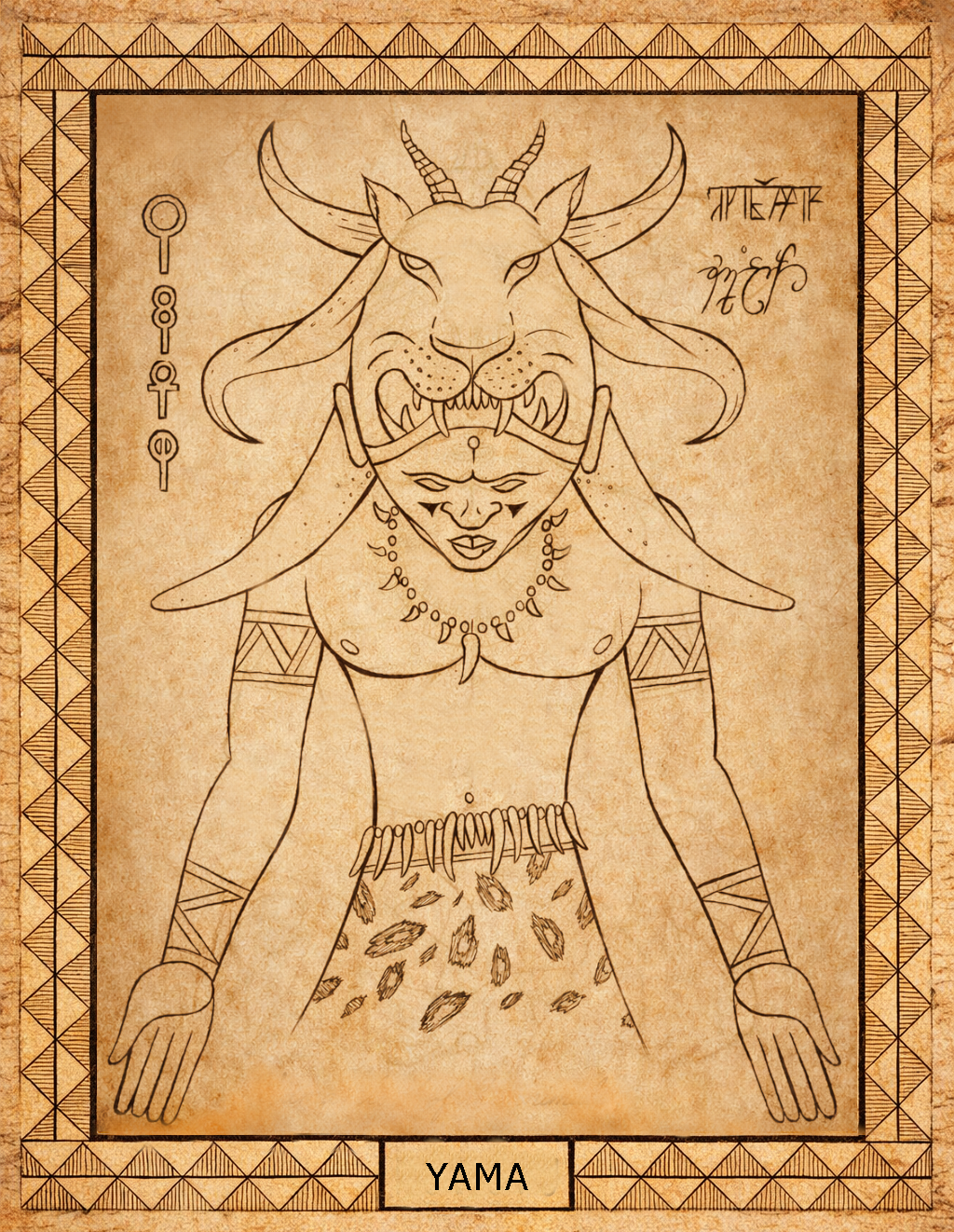
Yama
Yama is the god of animals. The name Yama literally translates as meat. He is the god who maintains a balance and harmony within the animal world, driving their independent struggles. He wears a necklace of animal teeth, representing animal potency. He is also responsible for making sure the hunters among mankind respect their prey and follow the forms and rituals required to honor the sacrifice animals make.
Yama represents the lowest instinctive levels of the subconscious, which is why the shaman is so dependent on this god in his work. Animals are integral in all three of the lower realms, thus Yama’s importance is ubiquitous as the go-between in accessing animal powers already within people. Yama helps integrate the animal into a person’s conscious awareness.
It is Yama who reveals to boys in a vision their totems during the jawar ben-bella. Yama looks deep into the hearts of each and assigns the appropriate animal as a guardian and guide. This totem connects a boy to ancestors who shared this totem, though it also reinforces bonds of kinship and his rights and duties as a man. A totem is not hereditary or genealogical, nor is it influenced by social organization in the tribe – such as clans. The association with a particular animal is strictly a personal and spiritual one.
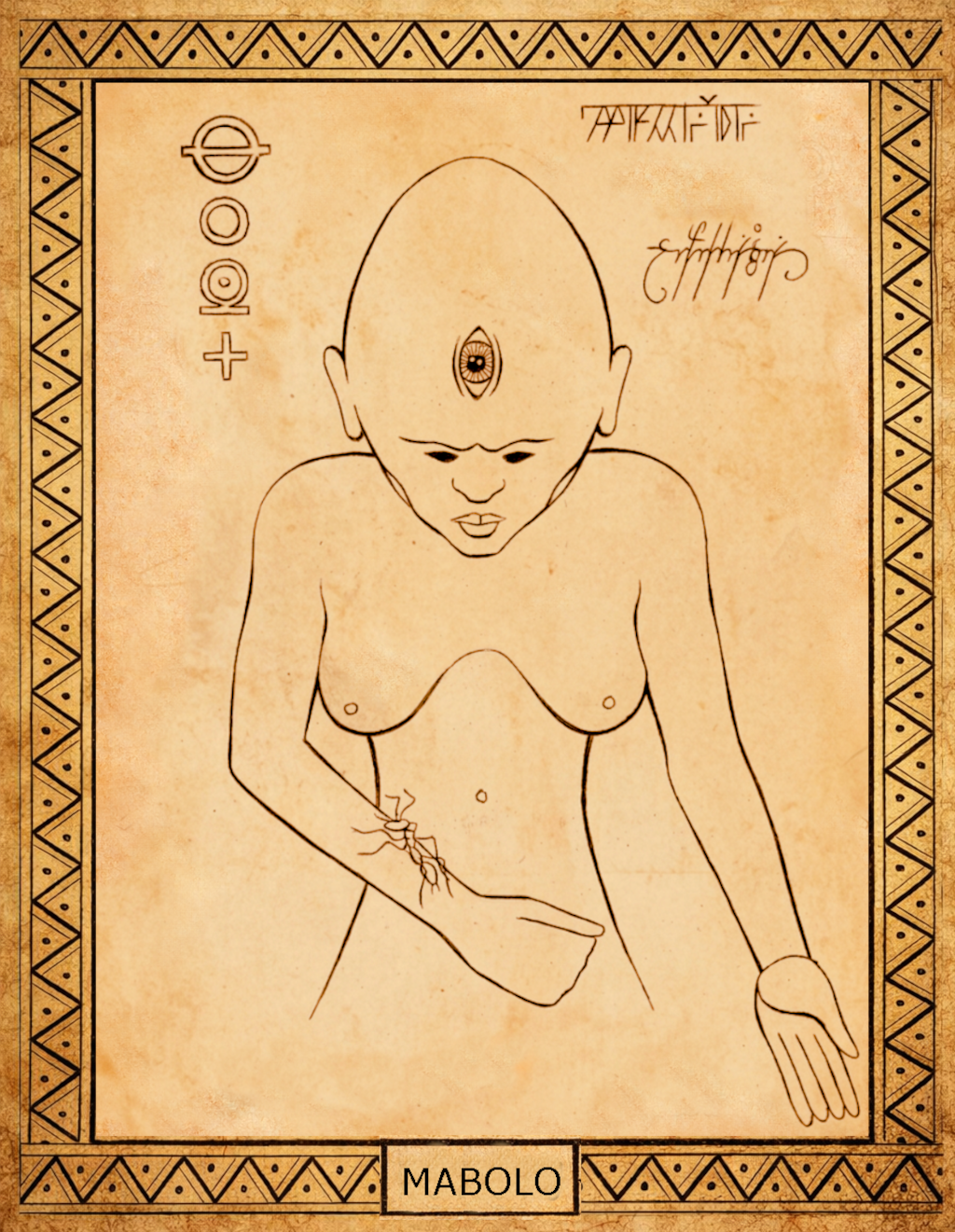
Mabolo
Mabolo is the goddess of death, often depicted as a dancing drummer. Beautiful, nude, pitch black skin, she is also severe looking. Her black skin glistens with sweat, sparkling like tiny stars. She’s completely bald with black cavernous eyes. Her lips are full with no trace of humor. A single large eye sets vertically within her forehead with a golden iris. She has perfect posture and composure, moving with insect-like precision. Her voice drips with honey in a chilling monotone.
Mabolo is ambivalent. Passionless.
The third eye set within her forehead is called Apara, symbolizing the sun that it’s named for. It is a source of life and light, even amid death and darkness. It’s golden iris is associated with fire, its glance reducing everything to ashes, destroying manifestations. The Eye of Wisdom, an organ of inward vision – The Eye of the Heart. Hers is the eye of clairvoyance at its highest level. She beholds all things, embracing the entire cosmos with one glance. Her other two eyes, invisible within their cavernous pits, have one fixed on time and the other on eternity.
Mabolo is associated with Cypress and Weeping Willow trees, Poppies, Asphodel flowers, and the Anemone – a wildflower that springs up where gods fall dead; a symbol of transience, fragility, and grief due to its ephemeral nature. She is also associated with the West, the entrance to the underworld, Alodia, and the Sea of Destruction.